How New York Attorneys Can Find Relevant Court Cases and Potential Legal Leads in 2026
For New York attorneys and law firms, identifying relevant court cases is an important part of legal research, business development, and understanding activity within specific practice areas. However, searching public court records, reviewing filings, and evaluating potential opportunities can require significant time and attention.
In 2026, AI-assisted legal research tools are creating new ways to organize publicly available court information. Instead of reviewing large numbers of unrelated filings, attorneys can use targeted searches, case filtering, and structured review workflows to focus on matters that are relevant to their practice.
This guide explains how to research New York court filings, narrow search results, evaluate potential legal leads, and use technology responsibly to support law firm growth.
Why New York Court Case Research Matters for Law Firms
New York courts handle a broad range of civil matters, including contract disputes, commercial litigation, foreclosure proceedings, consumer credit cases, and other legal actions.
For attorneys, public court information can provide insight into litigation trends, case activity, and areas where legal services may be relevant.
For example, a commercial litigation attorney may monitor newly filed business disputes. An attorney concentrating on foreclosure defense may research relevant foreclosure proceedings. A law firm handling civil litigation may study filing patterns across counties to better understand the legal market.
Importantly, the existence of a court filing does not automatically mean that a party needs representation or is an appropriate prospective client. Each matter requires careful evaluation.
Where Can Attorneys Search New York Court Cases?
1. New York State Courts Electronic Filing (NYSCEF)
The New York State Courts Electronic Filing system provides public search access to many electronically filed cases. Users can search by identifiers or names and narrow results using available search options.
Publicly accessible documents may include complaints, motions, orders, and other filings. Availability varies, and sealed, restricted, or otherwise protected records are not available for unrestricted public review.
Official resource: NYSCEF User Manual and Public Search Instructions.
2. New York Court Websites and Case Information Resources
New York's official court resources can help researchers understand court procedures, electronic filing requirements, and available case information.
Start with the New York State Unified Court System and select the appropriate court or filing resource.
3. AI-Assisted Court Case Research Platforms
Legal technology platforms can support research by helping users search, filter, summarize, and organize relevant case information.
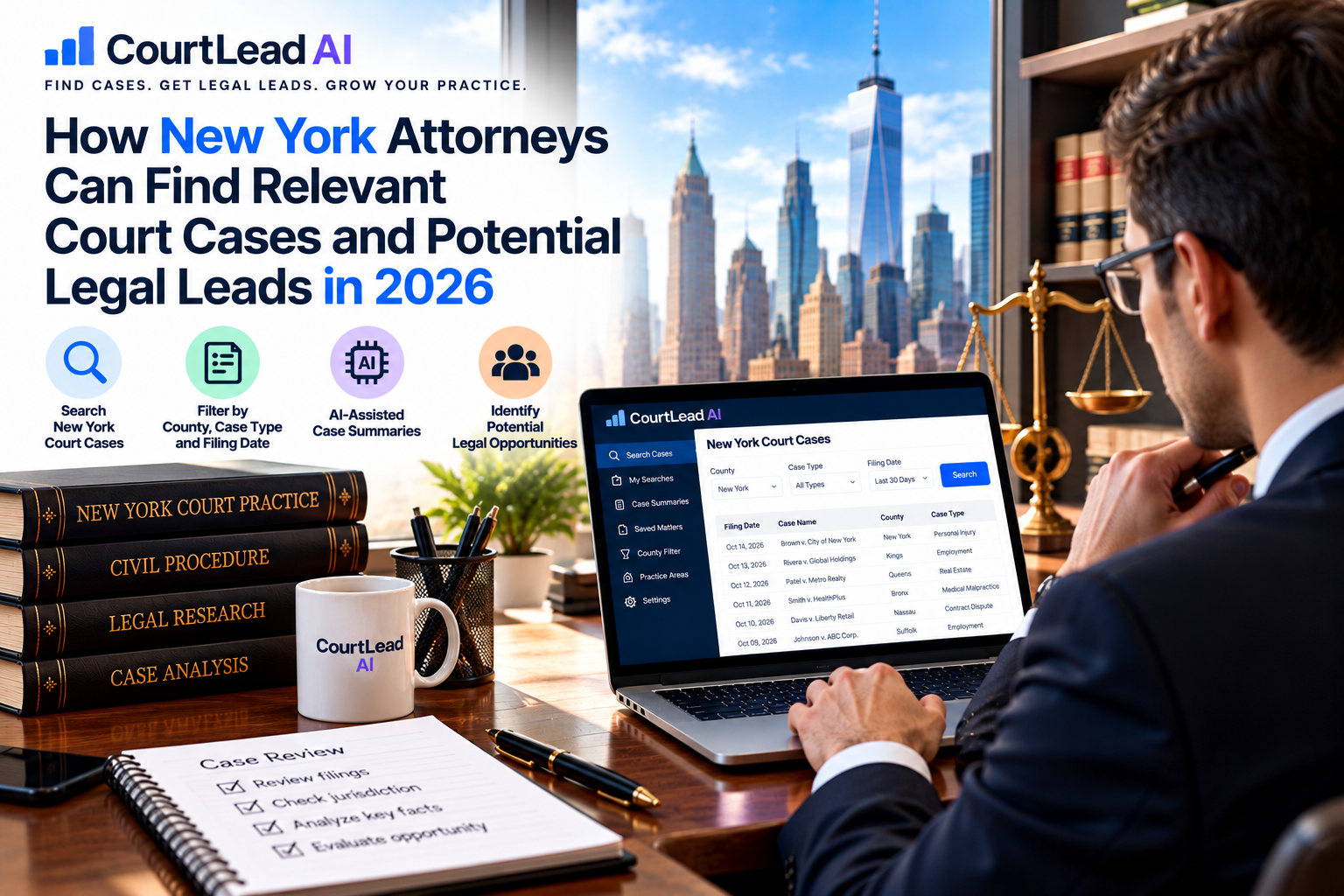
CourtLead AI is designed for New York attorneys and law firms interested in AI-assisted court case research and potential legal lead discovery.
How to Find Relevant Court Cases: A Practical Workflow
Step 1: Define Your Practice Area
Begin by identifying the types of cases that match your firm's experience and services. A clear practice-area focus helps reduce irrelevant search results.
Examples include commercial litigation, consumer credit matters, contract disputes, foreclosure cases, and other civil litigation categories.
Do not assume that every case within a category is suitable for outreach. Relevance is only the first screening step.
Step 2: Select the Counties You Serve
New York attorneys may focus their research on counties such as New York, Kings, Queens, Bronx, Nassau, Suffolk, or Westchester, depending on their practice and geographic coverage.
Searching by county can help organize research around the markets a firm actually serves.
Step 3: Focus on Filing Dates
Filing date filters can help distinguish recent activity from older cases. A firm studying newly filed matters may prioritize recent filings, while another firm conducting broader market research may examine a longer period.
The appropriate timeframe depends on the research objective, case type, and procedural context.
Step 4: Review the Case Details
Before classifying a case as relevant, examine the available information carefully. Useful details may include:
- Court and county
- Case type and filing date
- Parties and available representation information
- Nature of the dispute
- Case status and relevant procedural activity
- Publicly accessible documents
Never assume that a party is unrepresented merely because counsel is not immediately visible in a search result. Verify information against the official record.
Step 5: Build a Research Shortlist
Instead of treating every result as a potential lead, create a shortlist of cases that meet defined research criteria.
Record the case identifier, court, practice-area relevance, review status, and any questions requiring further verification.
A structured shortlist can help prevent duplicate research and support consistent internal review.
How AI-Assisted Research Can Improve the Workflow
AI can help make lengthy case materials easier to navigate, but it should be used as an assistant rather than a substitute for legal judgment.
Faster Initial Case Review
AI-generated summaries may help researchers identify the main subject of a filing and determine which documents deserve closer attention.
More Organized Case Filtering
Filtering by practice area, court, county, and other available criteria can help researchers concentrate on relevant records.
Better Internal Research Organization
Consistent case notes and shortlists can make it easier for a law firm to track what has been reviewed and what still requires attention.
Human Verification Remains Essential
AI-generated content can omit context or contain inaccuracies. Attorneys should verify material facts, procedural information, and citations against authoritative court records before relying on them.
What Makes a Court Case a Potential Legal Lead?
A potential legal lead is not simply a name found in a public filing. For a law firm, the value of a case depends on whether there is a legitimate connection between the matter and the firm's services, whether the party may need representation, and whether any communication would be lawful and professionally appropriate.
Consider these questions:
- Does the matter fall within the firm's practice area?
- Is the case located in a court or county the firm serves?
- Has the information been verified?
- Is there evidence of existing legal representation?
- Would outreach comply with applicable attorney advertising and solicitation rules?
- Does the firm have the capacity and competence to handle the matter?
Answering these questions helps distinguish useful research from indiscriminate prospecting.
Important Ethical Considerations for New York Attorneys
Public access to a court record does not create unrestricted permission to contact the individuals named in that record.
New York attorneys must consider applicable professional conduct rules concerning advertising, solicitation, communications with represented persons, confidentiality, and misleading statements.
New York updated its lawyer advertising framework in 2026. Firms should consult the current rules and relevant professional guidance before creating an outreach campaign.
Additional information is available through the New York State Bar Association's discussion of the 2026 advertising rule changes.
Attorney review is particularly important before using public case information for direct mail, email, or other targeted communications.
Common Court Case Research Mistakes to Avoid
Searching Without a Clear Practice-Area Strategy
Broad searches often produce large volumes of unrelated results. Start with specific case categories and geographic criteria.
Assuming Every Filing Represents a New Client Opportunity
Some parties already have counsel, do not require additional services, or may not be appropriate contacts. Treat filings as research information, not guaranteed leads.
Relying Entirely on AI Summaries
AI summaries can support preliminary review, but the underlying court documents remain essential for verification.
Ignoring Case Status
A matter's procedural status can materially affect its relevance. Review the docket rather than relying solely on a case title.
Overlooking Professional Conduct Requirements
Marketing activity must comply with current ethical rules. Build compliance review into the workflow before any outreach occurs.
How CourtLead AI Fits Into a New York Law Firm's Research Process
CourtLead AI is designed to bring several court research activities into a more organized workflow for attorneys and law firms.
Its focus includes public court case discovery, targeted filtering, AI-assisted case summaries, case review, and potential legal lead shortlisting.
For a small law practice, a structured research workflow can help reduce repetitive searching. For a larger firm, consistent research criteria can help team members evaluate matters more systematically.
The goal is not to replace an attorney's professional judgment. It is to help legal professionals identify relevant public information and decide what deserves closer examination.
A Simple Weekly Court Research Routine
Law firms can improve consistency by establishing a repeatable weekly research process.
- Choose the practice areas and counties to review.
- Search recent publicly accessible filings.
- Apply relevant case filters.
- Review case details and available documents.
- Verify important information against official records.
- Create an internal shortlist for attorney review.
- Evaluate any proposed outreach for ethical compliance.
- Record results and refine research criteria for the next review.
This approach can be adapted to a solo practice, a small law office, or a larger legal team.
Frequently Asked Questions
Can the public search New York court filings?
Yes. NYSCEF provides public search access to many electronically filed cases, although access to particular documents may be restricted.
Can attorneys search court cases by county?
Yes. NYSCEF provides county-related narrowing options for applicable public searches.
Can AI replace manual review of court documents?
No. AI can assist with initial review and organization, but material information should be checked against official records.
Does a new court filing mean someone needs a lawyer?
Not necessarily. The party may already be represented or may not require additional legal services.
Can court records be used for legal marketing?
Public records may inform lawful research and marketing strategies, but attorneys must comply with applicable professional conduct and privacy requirements.
Is CourtLead AI a law firm?
No. CourtLead AI provides legal research technology and does not offer legal representation or legal advice.
Conclusion: Make Court Case Research More Focused in 2026
Effective New York court case research starts with a clear strategy. Attorneys who define their practice areas, focus on relevant counties, review filing details, and verify information can build a more organized approach to understanding potential legal opportunities.
AI-assisted technology can support that process by simplifying case discovery, filtering, and preliminary review while leaving legal analysis and ethical decisions in the hands of qualified professionals.
Interested in a more structured approach to New York court case research?
Explore CourtLead AI to learn more about AI-assisted court research and potential legal lead discovery for New York attorneys and law firms.
Disclaimer: This article is provided for general informational purposes only and is not legal advice. Court record availability, platform functionality, and professional conduct requirements should be independently verified.