For a small New York law firm, finding a relevant court filing is only the beginning. The real challenge is developing a consistent process for reviewing documents, identifying matters related to the firm's practice, and deciding what deserves further attention.
Without a structured New York court case research workflow, attorneys may spend valuable time reopening the same filings, switching between research sources, and repeating work another team member has already completed.
The solution is not necessarily to research more cases. It is to organize research so every filing moves through a clear series of steps.
This guide explains how solo attorneys, small law firms, paralegals, and legal teams can establish a practical workflow for reviewing newly filed New York civil matters. It also explores how CourtLead AI can support that process without replacing attorney judgment.
Quick Answer: How Should New York Law Firms Organize Court Case Research?
Small New York law firms can organize court case research by defining relevant practice areas and counties, reviewing newly filed cases, checking original court documents, classifying matters by relevance, and maintaining a structured review list. AI-generated summaries may assist initial research, but attorneys should verify important information and independently determine appropriate next steps.
Why Does a Structured Court Research Workflow Matter?
Small law firms often operate with limited administrative and research resources. Attorneys may handle client meetings, litigation, document preparation, billing, and business development alongside court research.
When research is unstructured, even a straightforward task can become inefficient.
Consider a hypothetical two-attorney firm handling commercial litigation in Queens and Kings counties. One attorney searches for newly filed matters on Monday. The other reviews similar filings on Wednesday without knowing which cases have already been examined.
Some matters receive duplicate attention while others remain unreviewed. Notes are stored in different locations, and neither attorney has a complete view of the research already performed.
A shared workflow helps prevent this situation. Instead of treating every search as a separate activity, the firm can maintain a repeatable process for identifying, reviewing, classifying, and tracking relevant filings.
What Are the Seven Stages of an Effective Court Research Workflow?
- Define the firm's research priorities.
- Select relevant courts, counties, and case categories.
- Identify newly filed matters.
- Review and verify court information.
- Classify matters according to practice relevance.
- Maintain a structured research and review list.
- Make attorney-led decisions about appropriate follow-up.
Each stage serves a different purpose. Combining them into one unstructured activity can make it harder to understand where time is spent and which matters require attention.
Step 1: Define Your Law Firm's Research Priorities
Before reviewing filings, attorneys should determine what they are actually looking for. A foreclosure practice may have different research priorities from a firm handling consumer credit defense or merchant cash advance disputes.
Start by documenting the firm's relevant practice areas, geographic coverage, and types of matters it has the capacity and experience to evaluate.
- Consumer credit and debt collection disputes.
- Residential or commercial foreclosure matters.
- Merchant cash advance-related litigation.
- Commercial contract disputes.
- Other civil matters relevant to the firm's practice.
Research priorities should reflect the firm's actual legal services rather than simply the number of cases available for review.
A focused research process begins with the firm's practice, not with the largest possible list of court filings.
Step 2: Select the Right Counties and Case Categories
New York civil litigation spans numerous courts and counties. Small firms may find it more practical to begin with a defined geographic scope.
For example, a law firm serving New York City and nearby areas might prioritize certain counties based on its existing practice and professional capacity.
| Research Dimension | Example | Purpose |
|---|---|---|
| County | Kings, Queens, Nassau | Focus research geographically. |
| Case category | Consumer credit | Identify practice-area relevance. |
| Date range | Selected recent filing period | Organize review by filing date. |
| Special indicator | Merchant cash advance | Refine relevant commercial research. |
| Review status | New, reviewed, follow-up needed | Prevent duplicated research. |
These categories can be adapted to the firm's needs. The goal is to create a consistent research scope rather than change search criteria unpredictably.
Attorneys should also understand the coverage and limitations of each source they use. Search results should not automatically be interpreted as a complete inventory of every relevant New York proceeding.
Step 3: Establish a Repeatable Filing Review Schedule
A structured schedule can make research more predictable. For some firms, a brief daily review may be appropriate. Others may prefer a few designated research sessions each week.
The appropriate frequency depends on the firm's practice areas, workload, staffing, and research objectives.
Example Weekly Research Schedule
| Day | Research Activity |
|---|---|
| Monday | Identify newly available filings within selected categories. |
| Tuesday | Review documents and confirm key case information. |
| Wednesday | Classify potentially relevant matters. |
| Thursday | Conduct deeper attorney review where warranted. |
| Friday | Update research records and evaluate the workflow. |
This is an illustrative schedule, not a required approach. Firms should adjust it to operational needs, and urgent client obligations must receive appropriate priority.
Step 4: Review the Original Court Documents
After identifying a potentially relevant matter, the next stage is document review. Depending on the proceeding and available records, relevant documents may include a summons, complaint, exhibits, amended pleadings, or subsequent filings.
What Information Should Be Checked?
- Correct court and county.
- Case or index number.
- Names and roles of the parties.
- Filing date.
- Nature of the claims alleged.
- Relief requested.
- Relevant supporting documents.
- Available procedural developments.
The review should distinguish allegations from established facts. A complaint describes claims made by a party; it does not necessarily establish that those claims are true.
Attorneys should not infer procedural deadlines solely from an AI summary or initial filing date. Applicable requirements may depend on service, the relevant court, governing rules, and other circumstances.
Step 5: Classify Cases According to Practice Relevance
Not every filing that matches a search category will be relevant to a particular law firm. A useful classification system helps distinguish matters requiring additional research from those outside the firm's practice.
A Simple Three-Level Research Classification
Category A: Relevant for Further Attorney Review. The matter appears to fall within the firm's practice area and warrants additional professional assessment.
Category B: Additional Information Required. Available documents are incomplete, unclear, or insufficient to determine relevance.
Category C: Outside the Firm's Research Scope. The matter does not align with current practice, geographic coverage, or research priorities.
These categories describe internal research status. They do not establish that a party is seeking legal representation or that outreach would be permissible.
Step 6: Maintain a Structured Case Research Log
Even a small law firm can benefit from maintaining consistent research records. A controlled spreadsheet or appropriate case research platform may be sufficient if it meets security, confidentiality, and operational requirements.
Suggested Research Log Fields
| Field | Purpose |
|---|---|
| Review date | Record when the matter was examined. |
| Case identifier | Identify the correct court record. |
| County | Organize geographic research. |
| Case type | Group matters by practice area. |
| Research status | Track pending and completed reviews. |
| Assigned reviewer | Clarify responsibility. |
| Verification notes | Record issues requiring attention. |
| Next review action | Document the next internal step. |
Consistent recordkeeping can reduce duplicated work and make it easier for team members to understand what has already been reviewed. Access controls and data retention practices should be appropriate to the information maintained.
Step 7: Keep Professional Decisions With Attorneys
The final stage is professional evaluation. Identifying a public court filing does not establish that any person needs an attorney, wants representation, or may lawfully be contacted for marketing purposes.
Before considering outreach, attorneys should independently assess applicable professional conduct, advertising, solicitation, confidentiality, and privacy requirements.
Research staff and technology can assist with organizing information, but they should not independently determine legal strategy or whether outreach is appropriate.
How Can AI Improve the Initial Court Research Process?
AI-assisted research tools can help organize large amounts of text into manageable information. An AI-generated case summary may provide an initial overview of parties, allegations, and the nature of a dispute.
This can help a reviewer decide which documents require closer attention. However, AI-generated content may contain errors or omit important details. Original documents must remain the basis for factual verification and legal analysis.
Law firms should also consider how AI providers handle submitted information, especially when nonpublic or confidential material is involved.
Manual Research vs. an Organized Digital Workflow
| Research Activity | Unstructured Approach | Organized Approach |
|---|---|---|
| Case discovery | Separate searches without consistent criteria. | Defined filters and research scope. |
| Initial review | Documents reviewed without a shared process. | Consistent review checklist. |
| Case classification | Informal individual decisions. | Documented research categories. |
| Team coordination | Notes scattered across locations. | Shared records with access controls. |
| Verification | Varies by reviewer. | Defined source-checking requirements. |
| Follow-up | Dependent on memory. | Documented next steps. |
The main benefit of an organized workflow is consistency. Actual time savings depend on the firm's processes, case volume, and implementation.
How Does CourtLead AI Support New York Court Case Research?
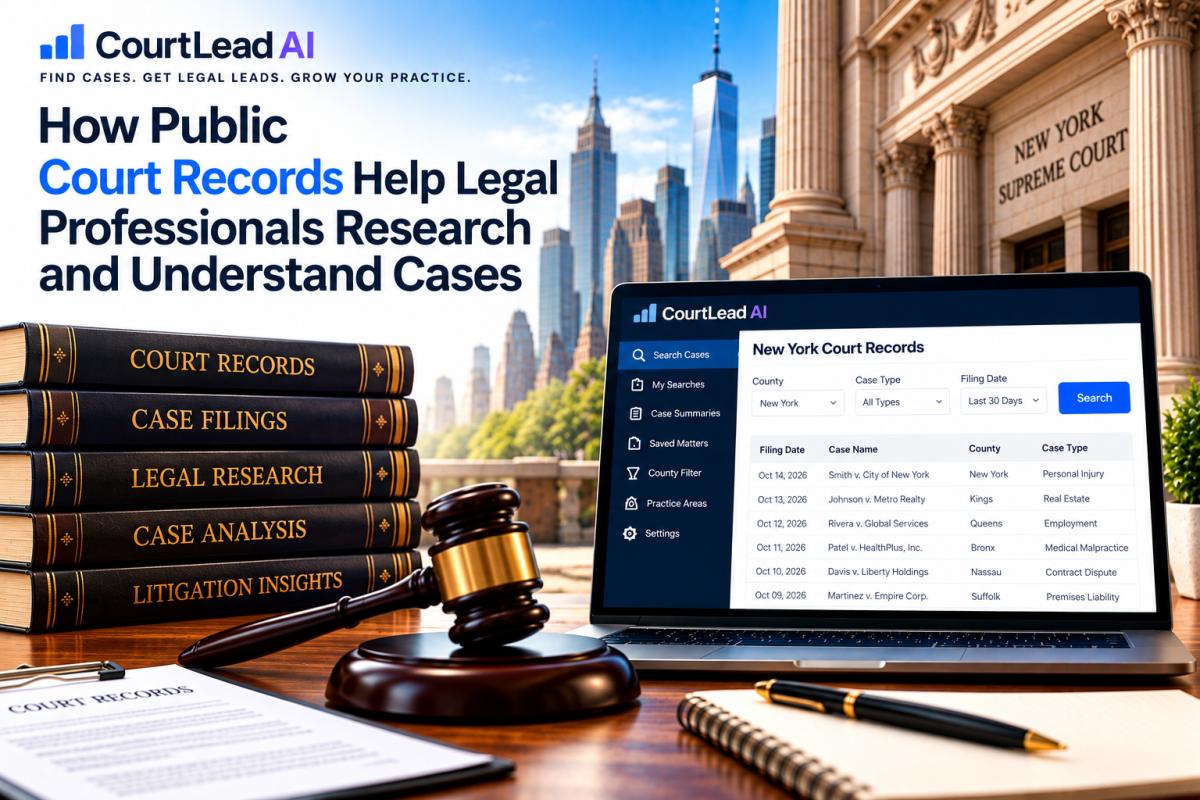
CourtLead AI is an AI-powered court intelligence and case-review platform for attorneys and legal teams researching newly filed New York court cases.
Its workflow allows users to:
- Select a date range, county, case type, and merchant cash advance indicator.
- View cases matching selected criteria.
- Review AI-generated case summaries.
- Shortlist matters for further consideration.
- Review prepared outreach letters.
These functions can support a structured initial research process. CourtLead AI does not automatically contact defendants or other parties. The platform prepares outreach letters for review, and the law firm controls whether outreach is appropriate and how it is conducted.
What Does CourtLead AI Cost?
CourtLead AI offers a monthly subscription of $145 or an annual subscription of $1,200, equivalent to $100 per month. Compared with 12 monthly payments, the annual subscription represents approximately 31% savings.
The stated pricing has no per-lead charges or hidden fees. Attorneys can review current subscription information on the CourtLead AI website.
What Mistakes Should Small Law Firms Avoid?
Researching Too Many Unrelated Case Categories
Broad searches may generate unnecessary review work. Begin with categories matching the firm's actual practice.
Failing to Verify Source Documents
Case descriptions and AI-generated summaries should not replace examination of underlying court filings.
Reviewing the Same Matter Repeatedly
Without shared research records, multiple team members may unknowingly repeat work.
Confusing a Filing With a Client Opportunity
A newly filed case does not prove that a party needs representation or is available for attorney solicitation.
Ignoring Information Security
Research records, internal notes, and client-related information should be handled according to the firm's security and confidentiality requirements.
How Can a Law Firm Measure Research Workflow Quality?
Instead of focusing only on the number of filings reviewed, firms can assess whether research produces useful, reliable information.
- Number of matters reviewed during a defined period.
- Percentage requiring additional verification.
- Number of duplicate research entries.
- Time spent on initial research and document review.
- Percentage of records with completed verification notes.
- Number of matters requiring further attorney assessment.
These measures can identify process problems without assuming more filings automatically produce more clients.
Frequently Asked Questions
What is a New York court case research workflow?
It is a structured process for finding, reviewing, verifying, classifying, and tracking court filings relevant to a law firm's research priorities.
How often should small law firms review new filings?
The appropriate schedule depends on practice areas, staffing, workload, and research objectives. A consistent schedule is generally more manageable than unpredictable searches.
Can paralegals help with court case research?
Paralegals and trained staff may assist with research and administrative tasks under appropriate attorney supervision. Legal judgments and professional responsibilities remain with the attorney.
Can AI-generated summaries replace court documents?
No. AI summaries can support initial review, but important facts and legal conclusions should be verified using authoritative source documents.
Does every newly filed case represent a potential client?
No. A filing does not establish that a party needs legal services, wants representation, or can appropriately be contacted.
Can CourtLead AI help organize research by county and case type?
Yes. CourtLead AI allows users to select counties, case types, date ranges, and an MCA indicator to view matching cases and review AI-generated summaries.
Does CourtLead AI send outreach letters automatically?
No. CourtLead AI prepares outreach letters for attorney review. The law firm decides whether outreach is appropriate and handles it independently.
Explore More CourtLead AI Resources
Attorneys interested in legal research, newly filed cases, and AI-assisted review can explore additional educational resources on the CourtLead AI Blog.
For platform information, visit CourtLead AI.
Connect With CourtLead AI
Existing customers who wish to share their experience may leave a Google review.
Conclusion: Build a Repeatable Research Process
For small New York law firms, effective court case research depends on more than finding new filings. It requires a repeatable process for evaluating relevance, checking original documents, organizing records, and making informed professional decisions.
A structured workflow can reduce unnecessary duplication and support greater consistency. AI-assisted tools can help, provided attorneys remain responsible for verification and legal judgment.
Explore a more organized approach to New York court case research.
Disclaimer: This article is for general informational and marketing purposes only and does not constitute legal advice. Attorneys should independently verify court information and comply with applicable professional conduct, advertising, solicitation, privacy, and confidentiality requirements.