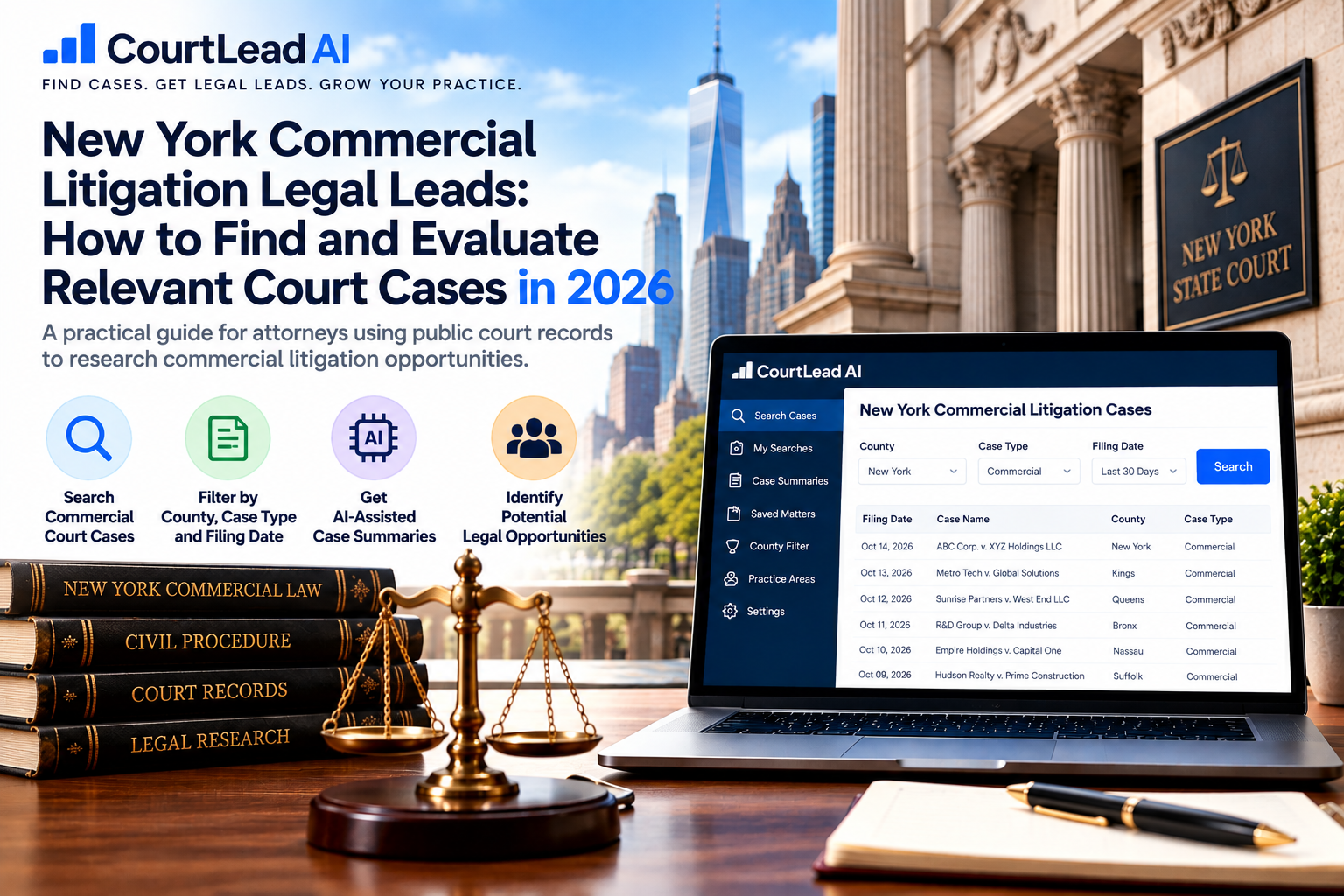
Commercial Litigation Legal Leads in New York: How Attorneys Can Find Relevant Court Cases in 2026
For commercial litigation attorneys in New York, finding relevant business disputes and monitoring newly filed lawsuits can support legal research, market intelligence, and responsible law firm business development.
New York businesses face a wide range of commercial disputes, including contract disagreements, payment conflicts, partnership disputes, and other civil litigation matters. Attorneys specializing in business litigation need efficient ways to identify cases that align with their practice areas and geographic markets.
Traditional court research can require examining multiple records, reviewing case classifications, and reading lengthy documents before determining whether a matter deserves further attention.
In 2026, AI-assisted legal research technology can help attorneys organize this process through targeted case discovery, county-based filtering, and preliminary case summaries.
CourtLead AI is designed to help New York attorneys and law firms discover relevant public court cases, narrow searches using selected criteria, and review AI-assisted case information.
This guide explains how commercial litigation attorneys can research public business disputes, evaluate potential legal opportunities, and decide whether a focused court research platform fits their practice.
What Are Commercial Litigation Legal Leads?
The phrase commercial litigation legal leads generally refers to potential business development opportunities associated with commercial legal disputes.
However, attorneys should distinguish between public litigation information and a qualified prospective client.
A publicly filed commercial lawsuit may identify a business dispute, but it does not establish that a party needs additional representation or is interested in hiring an attorney.
For responsible legal research, it is useful to distinguish between:
- Public commercial litigation records: Available court information concerning business-related lawsuits.
- Relevant commercial cases: Matters matching a law firm's practice areas and research criteria.
- Potential legal opportunities: Matters that may warrant additional professional evaluation.
- Qualified prospective clients: Individuals or organizations whose interest in legal services has been appropriately established.
These categories should not be treated as interchangeable.
Why New York Commercial Litigation Attorneys Need Targeted Court Research
New York has multiple courts and geographic markets. Commercial disputes can involve businesses operating in Manhattan, Brooklyn, Queens, the Bronx, Long Island, and other parts of the state.
A law firm that concentrates on commercial contract disputes may have little reason to review unrelated consumer or property litigation.
Targeted public court research helps attorneys focus on matters relevant to their professional experience.
A structured process may support:
- Research into recently filed business lawsuits.
- Monitoring of selected commercial litigation categories.
- County-specific litigation research.
- Preliminary review of publicly available case documents.
- Identification of recurring commercial dispute topics.
- Organization of relevant cases for attorney evaluation.
The objective is not simply to collect more records. It is to identify useful information while reducing time spent on unrelated matters.
Types of Commercial Litigation Cases Attorneys May Research
Commercial litigation includes several kinds of business-related disputes. The relevance of each category depends on the attorney's practice and the court's classification system.
Business Contract Disputes
Contract disputes may arise when businesses disagree about contractual obligations, performance, payments, or other terms.
Commercial litigation attorneys may examine publicly available pleadings to understand the allegations and relief requested.
Business Payment Disputes
Commercial payment litigation may involve disagreements concerning unpaid invoices, business transactions, or contractual financial obligations.
Attorneys should review the available documents before determining the nature of the dispute.
Partnership and Business Ownership Disputes
Business owners and partners may become involved in litigation concerning governance, contractual rights, or other business relationships.
These cases may involve complex factual and legal issues requiring careful document examination.
Commercial Real Estate Disputes
Some commercial litigation practices handle disputes associated with commercial property, leases, or business real estate transactions.
Attorneys should distinguish these matters from other real property litigation categories.
Other Business-Related Civil Litigation
Additional commercial cases may involve different contractual, financial, or business-related issues.
Case classifications are only a starting point. The underlying documents should be reviewed to determine relevance.
Step 1: Select the New York Counties Relevant to Your Commercial Litigation Practice
County-based research can help attorneys concentrate on geographic markets where they provide legal services.
Relevant New York jurisdictions may include:
- New York County, including Manhattan.
- Kings County, including Brooklyn.
- Queens County.
- Bronx County.
- Nassau County.
- Suffolk County.
For example, a hypothetical business litigation practice serving Manhattan and Brooklyn may prioritize relevant filings in New York and Kings Counties.
A Long Island firm may concentrate on Nassau and Suffolk Counties.
Attorneys should choose research locations based on actual practice coverage, professional capabilities, and client service areas.
Step 2: Use Commercial Litigation Case-Type Filters
Broad searches across all civil litigation categories may produce large numbers of unrelated records.
Where supported, case-type filters can help narrow results to commercial disputes relevant to the firm's services.
Attorneys may wish to research selected categories associated with business contracts, commercial disagreements, or other applicable civil claims.
However, case classification labels may not fully describe the underlying dispute.
Researchers should verify important information against the available pleadings and court documents.
Step 3: Monitor Newly Filed Business Lawsuits
Filing date research can help attorneys examine commercial litigation activity within a selected period.
A law firm may establish a daily, weekly, or monthly routine for reviewing relevant filings.
For example, a commercial litigation practice may research selected cases filed during the preceding week.
Attorneys should distinguish between a newly commenced action and a newly filed document in an existing proceeding.
Important dates and current procedural developments should be verified against official court records.
Step 4: Review Public Commercial Court Documents
After identifying a potentially relevant business dispute, attorneys should examine the available public records.
Depending on the proceeding, these may include complaints, motions, orders, and other filings.
Important research questions include:
- What type of commercial dispute is alleged?
- Who are the parties?
- What contractual or business relationship is described?
- What relief is requested?
- What procedural developments are visible?
- Which details require further verification?
Statements in complaints are allegations and should not be treated as proven facts.
Attorneys should also consider document availability, privacy restrictions, and the completeness of the public record.
Step 5: Use AI-Assisted Case Summaries for Preliminary Review
Commercial litigation documents can be lengthy and detailed.
AI-assisted summaries may help attorneys obtain an initial understanding of selected documents before deciding whether additional examination is necessary.
Potential uses include:
- Understanding the general nature of a business dispute.
- Identifying principal allegations.
- Recognizing the relief requested.
- Preparing questions for attorney review.
- Prioritizing documents requiring closer examination.
AI-generated information may contain errors, omissions, or misleading descriptions.
Attorneys must independently verify material information against source documents and exercise their own professional judgment.
Step 6: Evaluate Potential Legal Opportunities
Not every commercial lawsuit represents an appropriate business development opportunity.
Before proceeding with further evaluation, attorneys should consider:
- Whether the matter aligns with the firm's practice areas.
- Whether the court and jurisdiction are relevant.
- Whether sufficient public information is available.
- Whether the matter has undergone significant procedural developments.
- Whether the parties have legal representation.
- Whether applicable professional conduct rules permit any contemplated communication.
A public filing does not establish that a party is seeking new counsel or may be directly solicited.
How CourtLead AI Supports Commercial Litigation Research
CourtLead AI provides technology designed to help New York attorneys discover and research relevant public court cases.
For commercial litigation practices, its research approach includes several useful capabilities.
Public Court Case Discovery
Research relevant public New York civil litigation information within the platform's supported coverage.
County-Based Filtering
Focus on jurisdictions aligned with the firm's geographic market.
Case-Type Selection
Narrow searches to applicable commercial litigation classifications.
Filing Date Research
Examine selected filing periods to support ongoing litigation monitoring.
AI-Assisted Case Summaries
Review preliminary case information before conducting detailed document examination.
Potential Legal Opportunity Research
Organize relevant public case information for responsible attorney evaluation.
CourtLead AI does not guarantee clients, legal engagements, or particular business results.
Manual Commercial Litigation Research vs. Focused Software
| Research Activity | Manual Approach | Focused Research Software |
|---|---|---|
| County selection | Search relevant court sources separately | Apply supported geographic filters |
| Commercial case selection | Review available case categories manually | Use supported case-type filters |
| Recent filings | Check dates in available records | Apply selected filing date ranges |
| Preliminary case review | Read public documents directly | Use available summaries, then verify |
| Legal evaluation | Requires attorney judgment | Still requires attorney judgment |
The value of software depends on its actual court coverage, data quality, available features, and compatibility with the firm's research workflow.
Example: A Brooklyn Commercial Litigation Firm
Consider a hypothetical small law firm handling commercial contract disputes in Brooklyn and Queens.
The firm wants to organize its research into recently filed business lawsuits.
First: Define the Research Categories
The firm selects relevant commercial and contract-related litigation categories.
Second: Choose Geographic Markets
Research concentrates on Kings and Queens Counties.
Third: Apply a Filing Date Range
The team reviews selected filings associated with a recent period.
Fourth: Examine Relevant Cases
Researchers review available public information and preliminary AI-assisted summaries where appropriate.
Fifth: Verify Important Details
Material facts and procedural information are checked against current official court records.
Sixth: Conduct Attorney Evaluation
The attorneys determine which matters warrant further research and consider relevant ethical responsibilities.
This hypothetical example illustrates a research process, not a documented customer outcome or guarantee of new business.
How Commercial Litigation Research Can Support Law Firm Marketing
Public commercial litigation research can help attorneys understand the general types of business disputes appearing within their markets.
These observations may inform educational website articles and professional content.
For example, a law firm may publish helpful information about:
- Common commercial contract disputes.
- Business litigation procedures in New York.
- General considerations in partnership disputes.
- Commercial payment disagreements.
- Questions business owners may wish to discuss with qualified counsel.
Educational content should be accurate, useful, and consistent with applicable attorney advertising requirements.
Attorneys should avoid unsupported claims about litigation trends and unnecessary disclosure of personal information from specific cases.
What to Look for in Commercial Litigation Case Search Software
Before selecting a legal research platform, attorneys should evaluate whether it supports their actual needs.
Important considerations include:
- Coverage of relevant New York courts.
- Availability of required counties.
- Supported commercial litigation categories.
- Filing date search capabilities.
- Access to useful public case information.
- AI-assisted preliminary review features.
- Accuracy and verification options.
- Current subscription pricing and terms.
- Ease of use for the firm's research team.
Law firms should confirm current product capabilities before making purchasing decisions.
Common Mistakes When Researching Commercial Litigation Legal Leads
1. Treating Every Business Lawsuit as a Qualified Lead
A public case filing does not establish that a party needs or wants new representation.
2. Ignoring Geographic Relevance
Researching unrelated jurisdictions may consume time without supporting the firm's practice.
3. Searching Without Relevant Case Filters
Broad searches can produce unnecessary records.
4. Relying on Initial Filing Information Alone
Subsequent procedural developments may affect the current status of a case.
5. Trusting AI Summaries Without Verification
Automated descriptions should be checked against original documents.
6. Overlooking Attorney Representation
A party may already have counsel, and public information may be incomplete.
7. Ignoring Professional Conduct Requirements
Public records do not automatically authorize direct solicitation.
Frequently Asked Questions
How can New York attorneys find commercial litigation cases?
Attorneys can research public court records using relevant counties, commercial case classifications, and selected filing periods, then verify important information against official documents.
Can commercial litigation attorneys monitor newly filed business lawsuits?
Yes, where public record coverage and research tools permit. Filing dates and procedural information should be independently verified.
Can CourtLead AI help attorneys research business disputes?
CourtLead AI supports public New York court case discovery, selected filtering, and AI-assisted preliminary research within its available coverage.
Which New York counties are relevant for commercial litigation research?
That depends on the firm's practice. Relevant jurisdictions may include New York, Kings, Queens, Bronx, Nassau, Suffolk, and other counties served by the firm.
Can AI summarize commercial litigation documents?
AI-assisted tools may provide preliminary summaries of selected documents. Attorneys must verify material information against the original filings.
Does a commercial lawsuit automatically represent a legal lead?
No. A public filing does not establish that a party needs additional legal services or may appropriately be contacted.
Is CourtLead AI suitable for small law firms?
Small law firms may find focused research technology useful when its features, coverage, and cost align with their practices.
Does CourtLead AI guarantee new commercial litigation clients?
No. CourtLead AI supports public court case research and preliminary opportunity evaluation. It does not guarantee clients or legal engagements.
Explore More CourtLead AI Resources
Continue learning about New York public court records and legal research:
- How New York Attorneys Can Find Relevant Court Cases and Potential Legal Leads in 2026
- Public Court Records and Legal Research
Connect With CourtLead AI
- Follow CourtLead AI on Facebook
- Connect With CourtLead AI on LinkedIn
- Subscribe to CourtLead AI on YouTube
- Share Your CourtLead AI Experience on Google
Conclusion: Research New York Commercial Litigation More Efficiently
Commercial litigation attorneys need relevant, accurate, and current information when researching business disputes and public court filings.
By combining county-based searches, case-type filters, filing date research, source verification, and professional evaluation, law firms can establish a more focused approach to commercial litigation research.
AI-assisted technology can support preliminary case review, but it should complement rather than replace attorney judgment.
For New York law firms seeking a more organized way to discover relevant commercial litigation matters, CourtLead AI provides technology designed to support public court case discovery and preliminary legal opportunity research.
Find New York Court Cases. Get Legal Leads. Grow Your Practice.
Explore CourtLead AI for Your Commercial Litigation Practice
Disclaimer: This article is for general informational and marketing purposes only. It does not constitute legal advice. Attorneys should independently verify court information and comply with applicable professional conduct, advertising, solicitation, confidentiality, and privacy requirements.