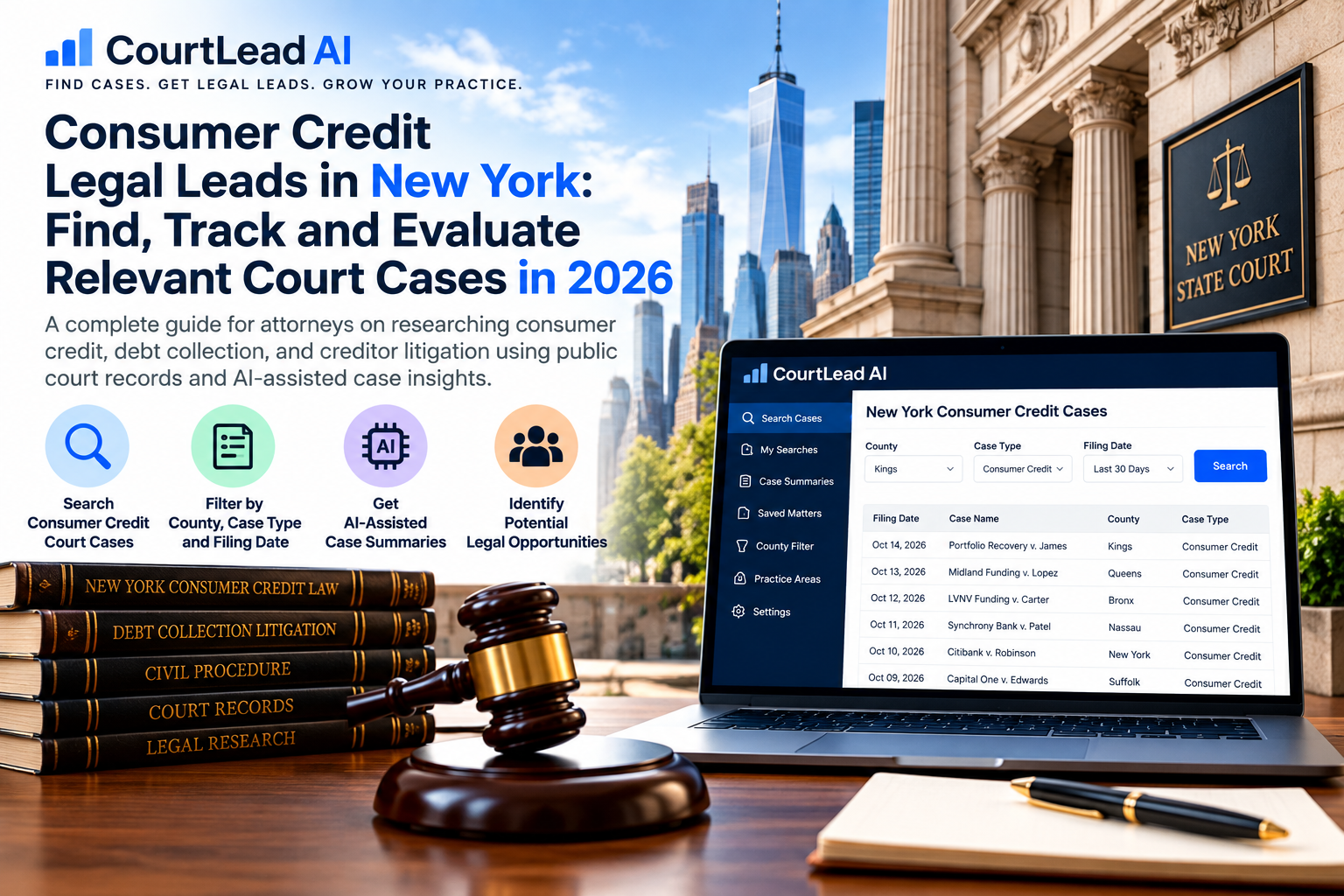
Consumer Credit Legal Leads in New York: Find, Track and Evaluate Court Cases in 2026
For New York attorneys handling consumer credit litigation, finding relevant court cases is an important part of legal research, litigation monitoring, and responsible law firm business development.
Consumer credit disputes can involve credit card accounts, debt collection lawsuits, original creditors, debt buyers, and other financial claims. Attorneys who work in this practice area need an organized way to identify relevant public filings and understand the matters appearing in the courts they serve.
However, researching consumer credit lawsuits across multiple New York counties can become time-consuming. Broad searches may return unrelated civil cases, while lengthy court documents can require substantial preliminary review.
In 2026, legal research technology offers another approach. Attorneys can use targeted case searches, county filters, filing date selections, and AI-assisted case summaries to organize preliminary research.
CourtLead AI helps New York attorneys and law firms discover relevant public court cases and evaluate potential legal opportunities through a more focused research process.
This guide explains how consumer credit attorneys can research public court records, monitor relevant filings, evaluate software tools, and build a practical workflow for responsible legal opportunity research.
What Are Consumer Credit Legal Leads?
The phrase consumer credit legal leads is often used to describe potential business development opportunities associated with consumer credit litigation.
However, attorneys should distinguish between a public court filing and a qualified prospective client.
A consumer credit lawsuit may reveal that a creditor has brought a claim against a defendant, but the filing does not establish whether the defendant needs an attorney, already has representation, or wishes to obtain legal services.
Likewise, the presence of a creditor or debt buyer in a lawsuit does not automatically establish an available business development opportunity.
Four concepts are especially important:
- Public court records: Information available through applicable court record systems.
- Relevant consumer credit cases: Matters matching a law firm's practice area and research criteria.
- Potential legal opportunities: Cases that may warrant further professional evaluation.
- Qualified prospective clients: People or organizations whose interest in legal services has been appropriately established.
Public court case discovery is a research activity. Client acquisition is a separate process governed by professional obligations and actual client interest.
Why New York Consumer Credit Attorneys Need Targeted Case Research
Consumer credit litigation can involve multiple categories of financial disputes and different types of plaintiffs.
Attorneys researching these cases may be interested in selected counties, creditor classifications, debt buyer lawsuits, or particular types of consumer credit proceedings.
Without focused search criteria, researchers may spend unnecessary time reviewing unrelated litigation.
A structured approach can help attorneys:
- Identify relevant public consumer credit filings.
- Focus on counties where the firm practices.
- Monitor selected filing periods.
- Distinguish consumer credit matters from unrelated civil disputes.
- Review available complaints and supporting documents.
- Organize matters requiring attorney examination.
- Understand recurring litigation issues within their practice areas.
The purpose is to improve the relevance and organization of research, not to assume that every lawsuit represents an available client.
Understanding Consumer Credit Litigation Categories in New York
Consumer credit litigation is not one uniform type of lawsuit.
Depending on the court classification and underlying documents, attorneys may encounter several categories.
Credit Card Debt Collection Lawsuits
Credit card debt litigation may involve claims concerning allegedly unpaid credit card accounts.
Attorneys researching these matters should examine the available complaint and supporting documentation to understand the nature of the allegations.
Original Creditor Plaintiff Cases
Some consumer credit actions are filed by the financial institution or original creditor associated with the account.
Researchers should verify the identity of the plaintiff and the allegations rather than relying solely on a classification label.
Debt Buyer Plaintiff Cases
Debt buyers may bring lawsuits concerning accounts they claim to have acquired.
Depending on the proceeding, relevant legal research questions may concern the alleged account, assignment documentation, procedural history, and other issues reflected in the record.
Secondary Debt Buyer Cases
Some litigation categories distinguish between different types of debt buyers or account acquisition arrangements.
Attorneys should verify the specific circumstances through the underlying public documents.
Non-Card Consumer Credit Transactions
Consumer credit disputes may also involve non-card financial obligations.
These matters should be evaluated according to the actual allegations and relevant legal issues.
Other Consumer Debt Matters
Additional cases may be classified under broader consumer debt or consumer credit categories.
The classification is a useful starting point, but the available pleadings remain important for determining relevance.
Step 1: Define Your Consumer Credit Practice Focus
Before researching public court cases, attorneys should identify the types of consumer credit matters their firm handles.
For example, one firm may concentrate on defending consumers in debt collection litigation, while another may represent creditors in selected financial disputes.
These practices have different research objectives.
Attorneys should establish:
- Relevant consumer credit case classifications.
- Preferred geographic jurisdictions.
- Relevant filing periods.
- Types of documents requiring examination.
- Internal criteria for further professional research.
Clear criteria can help reduce unrelated results and create a more manageable workflow.
Step 2: Select Relevant New York Counties
County-based research allows attorneys to concentrate on the geographic markets where they provide services.
Relevant counties may include:
- New York County (Manhattan).
- Kings County (Brooklyn).
- Queens County.
- Bronx County.
- Nassau County.
- Suffolk County.
- Other counties aligned with the firm's practice.
For example, a hypothetical consumer credit attorney practicing primarily in Brooklyn and Queens may prioritize available public filings from those jurisdictions.
A firm serving Long Island may focus on Nassau and Suffolk Counties.
Attorneys should verify the courts and counties supported by any research platform before purchasing or relying on it.
Step 3: Search by Consumer Credit Case Type
Broad civil case searches can produce records unrelated to consumer credit litigation.
Where supported, case-type filters help narrow research to relevant categories.
A firm may select classifications associated with credit card debt, original creditors, debt buyers, or other applicable consumer credit disputes.
However, classification labels do not necessarily describe every legal issue involved.
Researchers should examine available documents before determining whether a case matches the firm's professional focus.
Step 4: Monitor Newly Filed Consumer Credit Lawsuits
Filing date research can help attorneys organize consumer credit litigation activity by time period.
For example, a firm may review relevant public filings once a week.
A selected filing date range may help researchers focus on more recent activity rather than examining an unrestricted historical collection.
However, a recently filed document does not necessarily mean the underlying lawsuit is new.
Attorneys should verify the case commencement date and distinguish new actions from subsequent motions, orders, or other docket events.
Step 5: Examine Available Public Court Documents
After identifying a relevant consumer credit case, attorneys should review the available public documents.
Depending on the proceeding, these may include complaints, supporting exhibits, motions, orders, and other filings.
Important preliminary questions may include:
- Who is identified as the plaintiff?
- Who is named as the defendant?
- What financial obligation is alleged?
- What amount or relief is requested?
- What documents support the allegations?
- What procedural developments are visible?
- What information requires further verification?
Allegations should not be treated as established facts.
Attorneys should also account for access restrictions, incomplete records, and applicable privacy obligations.
Step 6: Use AI-Assisted Case Summaries
Consumer credit litigation documents may contain financial details, account-related allegations, and procedural information.
AI-assisted summaries can support preliminary review by helping researchers understand the apparent subject of selected filings.
Potential uses include:
- Identifying the general nature of the consumer credit dispute.
- Recognizing the plaintiff and defendant named in the source material.
- Summarizing principal allegations.
- Identifying requested relief.
- Highlighting questions for additional document review.
- Helping attorneys prioritize relevant matters.
However, automated summaries may contain mistakes, omit important context, or misinterpret legal terminology.
Attorneys must independently verify material information against original court documents.
AI-assisted review should complement, not replace, professional legal analysis.
Step 7: Evaluate Potential Legal Opportunities Responsibly
Identifying a relevant lawsuit does not automatically establish an appropriate opportunity for client outreach.
Before taking any further action, attorneys should consider:
- Practice-area relevance.
- Geographic and jurisdictional relevance.
- Current procedural status.
- Available representation information.
- Accuracy of the underlying records.
- Applicable professional conduct requirements.
A defendant may already have legal counsel. A creditor may have an established attorney relationship. Public records may not show the full circumstances.
Attorneys must consider applicable New York advertising, solicitation, and contact rules before undertaking communications based on court information.
How CourtLead AI Supports Consumer Credit Case Research
CourtLead AI is designed to help New York attorneys and law firms discover relevant public court cases and organize preliminary legal research.
For consumer credit litigation practices, its research approach offers several useful capabilities.
Public Court Case Discovery
Research relevant public New York litigation information within the platform's supported coverage.
County-Based Filtering
Focus on geographic jurisdictions aligned with the firm's practice.
Case-Type Selection
Narrow research to supported consumer credit and related litigation categories.
Filing Date Research
Examine selected filing periods to support ongoing case monitoring.
AI-Assisted Case Summaries
Use preliminary case descriptions to identify documents requiring closer examination.
Potential Legal Opportunity Research
Organize relevant public case information for further professional evaluation.
CourtLead AI does not guarantee clients, legal engagements, or specific financial results.
Consumer Credit Case Research: Manual Searching vs. Focused Software
| Research Activity | Manual Research | Focused Research Software |
|---|---|---|
| County selection | Search relevant sources individually | Apply supported geographic filters |
| Consumer credit categories | Review available classifications manually | Use supported case-type filters |
| Recent filing research | Examine dates in available records | Apply selected filing periods |
| Preliminary document review | Read available documents directly | Use AI-assisted summaries where available, then verify |
| Legal evaluation | Requires attorney judgment | Still requires attorney judgment |
The usefulness of software depends on its actual features, court coverage, data quality, and suitability for the firm's research requirements.
Example: A Brooklyn Consumer Credit Litigation Practice
Consider a hypothetical small law firm handling consumer credit defense matters in Kings and Queens Counties.
The firm wants to create a weekly research routine for reviewing relevant public filings.
First: Define Relevant Case Categories
The firm selects applicable consumer credit and debt collection classifications.
Second: Choose Geographic Markets
Research focuses on Kings and Queens Counties.
Third: Apply a Filing Date Range
The team examines public records associated with a selected recent period.
Fourth: Review Preliminary Case Information
Researchers identify matters requiring closer examination and review available summaries where appropriate.
Fifth: Verify Source Documents
Important allegations, dates, and procedural information are checked against current official court records.
Sixth: Conduct Attorney Evaluation
Qualified attorneys determine which matters warrant further research and consider applicable professional responsibilities.
This is a hypothetical example of a research process, not a documented CourtLead AI customer result or guarantee of new business.
Why Consumer Credit Attorneys Should Evaluate Dedicated Research Software
Law firms researching consumer credit litigation should compare software based on practical requirements rather than general marketing promises.
Important considerations include:
- Coverage of relevant New York courts.
- Availability of preferred counties.
- Supported consumer credit case classifications.
- Filing date search capabilities.
- Access to relevant public case information.
- AI-assisted preliminary review features.
- Accuracy and source verification options.
- Ease of use.
- Current pricing and subscription terms.
Attorneys should confirm current product capabilities before making a purchasing decision.
How Consumer Credit Research Can Support Law Firm SEO
Public litigation research can also help attorneys understand general legal questions associated with consumer credit disputes.
These observations may inform educational website content.
For example, a consumer credit law firm may publish articles addressing:
- What happens after a debt collection lawsuit is filed in New York?
- What is the difference between an original creditor and a debt buyer?
- What information appears in a consumer credit complaint?
- What questions should consumers ask when facing a collection lawsuit?
- How do court procedures differ among relevant jurisdictions?
Educational content can help prospective clients understand legal issues and the firm's services.
Attorneys should ensure that marketing content is accurate, does not make unsupported promises, and complies with applicable professional conduct requirements.
Building a Weekly Consumer Credit Litigation Research Workflow
A repeatable research schedule may help attorneys manage their time more effectively.
Monday: Identify Relevant Cases
Research selected counties and consumer credit classifications.
Tuesday: Organize Results
Remove unrelated matters and identify records requiring further examination.
Wednesday: Review Documents
Examine available public documents and preliminary AI-assisted summaries.
Thursday: Verify Information
Check important details and current procedural developments against official records.
Friday: Conduct Attorney Review
Evaluate relevant matters and identify broader research insights.
This schedule is illustrative. Firms should adapt it to their staffing, caseload, and professional responsibilities.
Common Mistakes in Consumer Credit Legal Lead Research
1. Treating Every Debt Collection Case as a Qualified Lead
A public lawsuit does not establish that a party is interested in hiring an attorney.
2. Searching Without Relevant Case Filters
Broad searches can produce unnecessary records and increase review time.
3. Ignoring County Relevance
Research should reflect the firm's actual geographic practice.
4. Relying on Initial Filings Alone
Later procedural developments may change the current status of a case.
5. Trusting AI Summaries Without Verification
Automated information should be checked against original court documents.
6. Overlooking Representation Status
A party may already be represented by legal counsel.
7. Ignoring Professional Conduct Requirements
Public court information does not automatically authorize targeted solicitation.
8. Focusing on Research Volume Instead of Relevance
Collecting large numbers of unrelated cases does not necessarily improve business development.
Frequently Asked Questions About Consumer Credit Legal Leads
How can New York attorneys find consumer credit lawsuits?
Attorneys can research relevant public court filings using supported county, case-type, and filing date filters, then verify important information against official records.
Can attorneys monitor newly filed debt collection cases?
Yes, where public record access and research tools permit. Filing dates and current case information should be independently verified.
What is the difference between an original creditor and a debt buyer?
An original creditor is generally the entity associated with the original credit relationship. A debt buyer generally acquires accounts or debts from another party. The relevant circumstances should be verified in each case.
Can CourtLead AI help with consumer credit case research?
CourtLead AI supports public New York court case discovery, selected research filters, and AI-assisted preliminary review within its available coverage.
Can AI summarize debt collection lawsuit documents?
AI-assisted tools may support preliminary summaries of selected filings. Attorneys must verify material details against the source documents.
Does a debt collection lawsuit automatically represent a legal lead?
No. A public filing does not establish that a party needs additional representation or may appropriately be contacted.
Is consumer credit research software useful for solo attorneys?
It may be useful when the software's features, court coverage, and cost align with the attorney's practice and research needs.
Does CourtLead AI guarantee new consumer credit clients?
No. CourtLead AI provides research technology and does not guarantee clients, engagements, or business outcomes.
What should attorneys check before purchasing legal research software?
Attorneys should review court coverage, relevant case classifications, filing date filters, available documents, AI limitations, pricing, and professional compliance considerations.
How can I learn more about CourtLead AI?
Visit the official CourtLead AI website to explore the platform and its available services.
Related CourtLead AI Legal Research Resources
Continue learning about public court records, litigation research, and potential legal opportunity discovery:
- How New York Attorneys Can Find Relevant Court Cases and Potential Legal Leads in 2026
- Public Court Records and Legal Research
Connect With CourtLead AI
Follow CourtLead AI for information about New York court case research, legal technology, and AI-assisted preliminary document review.
- Follow CourtLead AI on Facebook
- Connect With CourtLead AI on LinkedIn
- Subscribe to CourtLead AI on YouTube
- Share Your CourtLead AI Experience on Google
Conclusion: Make New York Consumer Credit Case Research More Focused
Consumer credit attorneys need relevant, accurate, and current information when researching debt collection lawsuits and other financial litigation matters.
By combining county-based searches, consumer credit case classifications, filing date research, source verification, and professional evaluation, law firms can develop a more organized approach to public court case research.
AI-assisted technology may support preliminary document review, but it should complement rather than replace attorney judgment.
For New York law firms seeking a focused way to discover relevant consumer credit litigation matters, CourtLead AI provides technology designed to support public court case discovery and preliminary legal opportunity research.
Find New York Court Cases. Get Legal Leads. Grow Your Practice.
Explore CourtLead AI for Your Consumer Credit Litigation Practice
Disclaimer: This article is for general informational and marketing purposes only. It does not constitute legal advice. Attorneys should independently verify court information and comply with applicable professional conduct, advertising, solicitation, confidentiality, privacy, and technology responsibilities.