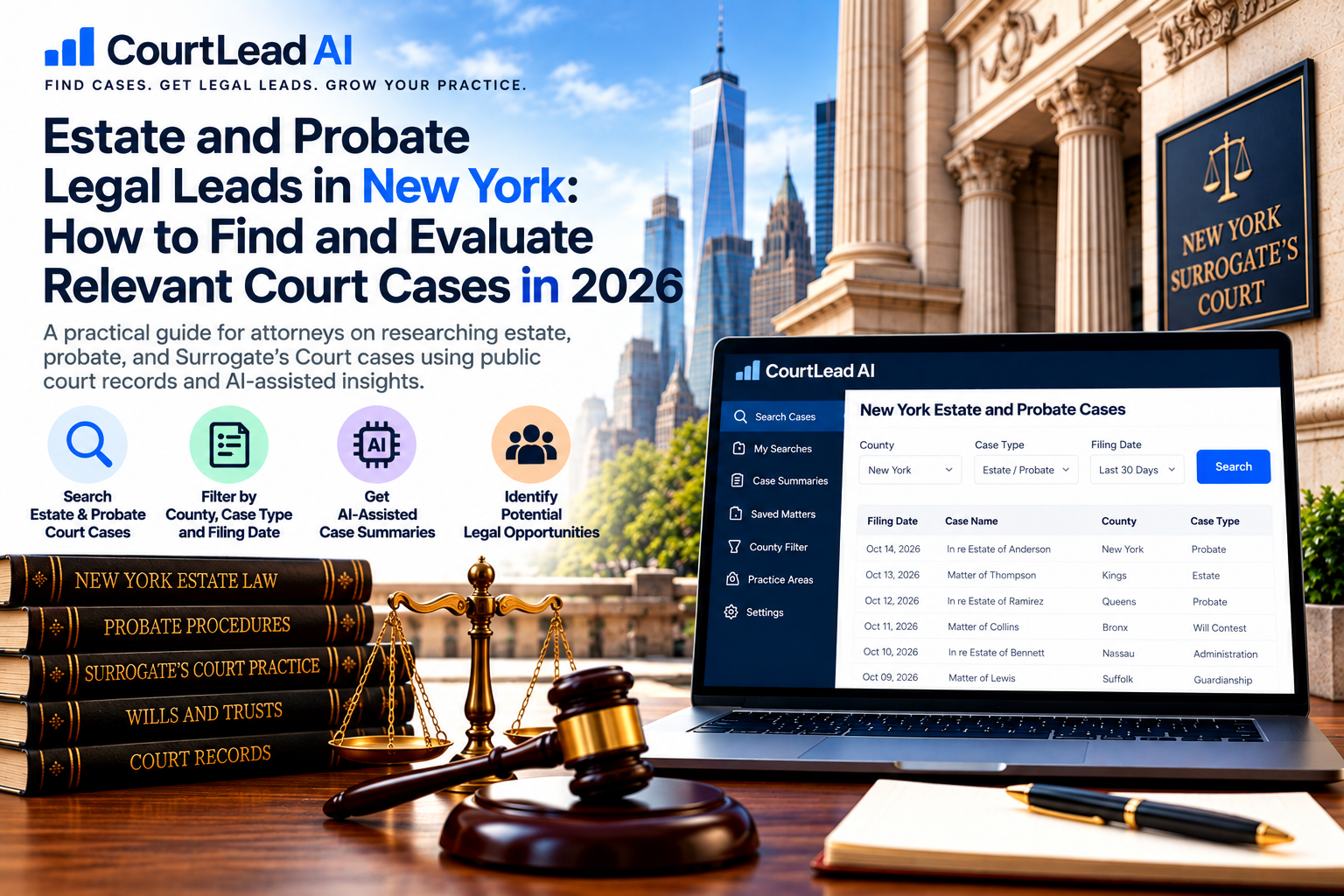
Estate and Probate Legal Leads in New York: How Attorneys Can Find and Evaluate Relevant Court Cases in 2026
For New York estate and probate attorneys, researching relevant court proceedings can support legal analysis, professional education, litigation monitoring, and responsible law firm business development.
Estate-related proceedings may involve probate petitions, administration matters, contested wills, fiduciary disputes, accounting proceedings, and other questions concerning the management or distribution of an estate.
Attorneys practicing in this field often need to examine court information carefully because estate matters can involve multiple interested parties, complex family relationships, financial questions, and sensitive personal circumstances.
In 2026, legal research technology can help attorneys organize publicly available information, identify relevant proceedings, and conduct preliminary case analysis where appropriate records are accessible.
CourtLead AI is a New York-focused legal research platform designed to support public court case discovery, targeted filtering, and AI-assisted preliminary case review within its supported coverage.
Estate and probate attorneys should confirm whether the particular Surrogate's Court proceedings and records they need are included in any platform before relying on it.
This guide explains how attorneys can research estate and probate matters, understand important case categories, evaluate potential legal opportunities responsibly, and assess whether research technology fits their practice.
What Are Estate and Probate Legal Leads?
The phrase estate and probate legal leads is sometimes used to describe potential legal business opportunities associated with estate administration, probate proceedings, and related litigation.
However, a public court filing is not automatically a qualified prospective client.
A probate petition may indicate that an estate proceeding exists, but it does not establish that any interested person needs additional legal representation or wishes to hire an attorney.
Similarly, the existence of a contested estate matter does not establish that the parties are unrepresented or that targeted solicitation is appropriate.
Attorneys should distinguish among:
- Public estate court records: Information lawfully available for legal research.
- Relevant probate proceedings: Matters aligned with a firm's professional practice and geographic focus.
- Potential legal opportunities: Matters that may warrant additional professional evaluation.
- Qualified prospective clients: Individuals or organizations whose interest in legal services has been appropriately established.
This distinction is especially important because probate proceedings can involve bereavement and other sensitive personal circumstances.
Understanding New York Surrogate's Court
In New York, Surrogate's Court generally handles probate, estate administration, and various other proceedings concerning decedents' estates.
Surrogate's Court practice is different from ordinary civil litigation in Supreme Court.
Attorneys should identify the appropriate court and proceeding type before beginning research.
Public access to estate-related records may vary depending on the nature of the matter, applicable restrictions, and the documents involved.
Some records may be sealed, confidential, or otherwise unavailable for public inspection.
Consequently, a platform that provides New York Supreme Court civil litigation information should not automatically be assumed to provide Surrogate's Court case coverage.
Common Estate and Probate Matters Attorneys May Research
1. Probate Proceedings
Probate proceedings generally concern the legal process associated with admitting a decedent's will to probate and addressing related estate administration matters.
Attorneys may review available petitions, procedural developments, and other accessible documents to understand the nature of the proceeding.
2. Estate Administration Proceedings
Administration proceedings may arise when a decedent dies without a valid will or where other circumstances require appointment of an administrator.
Attorneys should examine the relevant public records to understand the requested relief and the parties involved.
3. Will Contests
Contested probate matters may involve objections concerning the validity of a will.
Issues can include testamentary capacity, undue influence, execution requirements, or other questions depending on the circumstances.
Allegations in court documents should not be treated as established findings.
4. Fiduciary Disputes
Estate litigation may involve disputes concerning executors, administrators, trustees, or other fiduciaries.
Attorneys researching these matters should consider the procedural context and available source documents.
5. Estate Accounting Proceedings
Accounting proceedings may involve the examination of financial information and fiduciary conduct associated with an estate.
These matters can require detailed professional review.
6. Other Surrogate's Court Proceedings
Surrogate's Court may also handle additional matters within its jurisdiction.
Attorneys should verify the exact nature of each proceeding rather than relying solely on a general classification.
Why Estate and Probate Attorneys Need a Focused Research Strategy
Estate and probate law firms often practice within defined geographic markets and handle specific categories of proceedings.
A Manhattan estate litigation attorney may have different research needs from a Long Island firm concentrating on probate administration.
Focused research can help attorneys:
- Identify relevant publicly accessible estate proceedings.
- Understand the types of matters appearing in selected jurisdictions.
- Review appropriate court documents.
- Monitor procedural developments where information is available.
- Organize research by proceeding type.
- Identify questions requiring additional professional examination.
The goal is accurate and relevant research rather than the collection of large amounts of personal information.
Step 1: Define Your Estate and Probate Practice Focus
Before researching court records, attorneys should identify the kinds of estate matters their firm handles.
For example, one practice may concentrate on contested wills and fiduciary litigation, while another may primarily handle probate administration.
These practices have different research objectives.
Useful preliminary questions include:
- Which estate and probate matters does the firm handle?
- Which courts and counties are relevant?
- What information is publicly accessible?
- Which records may be restricted?
- What documents require attorney examination?
- What ethical and privacy requirements apply?
Establishing these criteria can help attorneys conduct more purposeful research.
Step 2: Identify the Relevant New York Counties
New York estate and probate attorneys may serve one county or multiple neighboring jurisdictions.
Potential research markets include:
- New York County (Manhattan).
- Kings County (Brooklyn).
- Queens County.
- Bronx County.
- Richmond County (Staten Island).
- Nassau County.
- Suffolk County.
- Other counties relevant to the firm's practice.
For example, a hypothetical probate attorney serving Nassau and Suffolk Counties may focus on lawfully accessible estate proceedings in those jurisdictions.
Attorneys should confirm the relevant Surrogate's Court and the availability of the desired records.
County-based filtering in a general civil litigation platform does not necessarily mean that Surrogate's Court information is included.
Step 3: Determine Which Probate Records Are Publicly Accessible
Public access to estate-related court information can vary.
Some documents may be available for inspection, while others may be restricted because of confidentiality requirements or the nature of the proceeding.
Attorneys should verify:
- The court handling the proceeding.
- Whether the case information is publicly accessible.
- Whether specific documents can lawfully be reviewed.
- Whether access restrictions apply.
- Whether the information is current.
- Whether a research platform actually includes the relevant records.
Researchers should not assume that all estate documents are publicly available or appropriate for marketing use.
Step 4: Research Probate and Estate Filing Dates
Where accessible, filing dates can help attorneys organize research into selected periods.
A firm may examine relevant proceedings weekly or monthly depending on its research objectives.
However, a newly filed document does not necessarily mean a new estate proceeding has begun.
Subsequent petitions, objections, motions, or orders may be associated with an existing matter.
Important dates and current procedural information should be independently verified against the appropriate court records.
Step 5: Review Available Estate and Probate Documents
After identifying a relevant proceeding, attorneys should examine lawfully accessible documents.
Depending on the matter, these may include petitions, objections, orders, accountings, or other filings.
Important preliminary research questions include:
- What type of proceeding is involved?
- Which court has jurisdiction?
- What relief is requested?
- Who are the parties identified in the public record?
- What procedural developments are visible?
- Which information requires additional verification?
Estate documents can contain sensitive personal and financial information.
Attorneys should use appropriate safeguards and avoid collecting or disclosing unnecessary private information.
Step 6: Use AI-Assisted Case Summaries Where Appropriate
AI-assisted legal research tools may support preliminary review of available documents.
Where a platform supports the relevant proceeding and document type, automated summaries may help describe:
- The apparent nature of the estate proceeding.
- The relief requested.
- Principal allegations in a contested matter.
- Relevant procedural questions.
- Documents requiring closer attorney examination.
However, AI-generated information may contain errors, omissions, or misleading descriptions.
Attorneys should verify material information against original court documents and exercise independent professional judgment.
AI summaries should not be treated as legal conclusions or substitutes for careful estate litigation analysis.
Step 7: Evaluate Potential Legal Opportunities Ethically
Estate-related proceedings can involve grieving family members, vulnerable individuals, and sensitive disputes.
Attorneys should exercise particular care when considering business development activity associated with these matters.
Before taking further action, attorneys should consider:
- Whether the matter aligns with the firm's professional practice.
- Whether the information is lawfully available.
- Whether the relevant parties have legal representation.
- Whether the proceeding is current.
- Whether the information is accurate and complete.
- Whether applicable professional conduct rules permit the contemplated communication.
- Whether privacy and confidentiality concerns arise.
A public estate filing does not automatically authorize targeted attorney solicitation.
How CourtLead AI Supports New York Public Court Case Research
CourtLead AI is designed to help attorneys and law firms discover relevant public New York court cases using targeted research criteria and AI-assisted preliminary case information.
Its general research approach includes several capabilities.
Public Court Case Discovery
Research relevant public New York civil litigation information within supported courts and case categories.
County-Based Filtering
Focus on geographic jurisdictions aligned with the firm's practice.
Case-Type Selection
Narrow searches to supported litigation classifications.
Filing Date Research
Examine selected filing periods where supported.
AI-Assisted Preliminary Review
Use case summaries to support initial examination of available documents.
Important: Estate and probate attorneys should confirm whether CourtLead AI currently supports the particular Surrogate's Court proceedings and documents they need. General New York civil litigation coverage does not establish probate or Surrogate's Court coverage.
Manual Estate Research vs. Legal Research Software
| Research Activity | Manual Approach | Research Software |
|---|---|---|
| Court identification | Determine the appropriate court and records system | Confirm whether the platform covers the court |
| County research | Examine relevant county records individually | Use geographic filters where supported |
| Proceeding categories | Review available classifications and documents | Use supported case-type filters |
| Filing dates | Check dates in available records | Apply date filters where available |
| Document review | Read lawfully accessible documents directly | Use summaries where supported, then verify |
| Legal evaluation | Attorney judgment required | Attorney judgment still required |
The usefulness of software depends on its actual court coverage, available records, accuracy, and compatibility with the firm's professional responsibilities.
Example: A Nassau County Probate Attorney Building a Research Workflow
Consider a hypothetical probate attorney whose practice serves Nassau County.
The attorney wants to establish an organized method for researching publicly accessible estate proceedings.
First: Identify the Appropriate Court
The attorney determines which Surrogate's Court handles the relevant proceeding.
Second: Confirm Record Availability
The attorney checks which case information and documents are lawfully accessible.
Third: Define Relevant Proceeding Types
Research concentrates on probate administration or contested estate matters aligned with the practice.
Fourth: Examine Available Documents
The attorney reviews relevant public information and identifies issues requiring additional research.
Fifth: Verify Important Details
Material information is checked against the appropriate source records.
Sixth: Conduct Professional Evaluation
The attorney determines whether further research is warranted and considers applicable ethical responsibilities.
This hypothetical example illustrates a research workflow. It does not represent a documented CourtLead AI customer result or guarantee of new business.
How Estate and Probate Research Can Support Law Firm SEO
Estate and probate attorneys can use general research insights to identify educational topics relevant to their practices.
Useful website content may address questions frequently encountered by people seeking estate-related legal information.
Potential topics include:
- What is probate in New York?
- What does New York Surrogate's Court handle?
- What is the difference between probate and estate administration?
- When might a will contest arise?
- What responsibilities can an estate executor have?
- What questions should families ask an estate attorney?
- How can interested parties understand the general stages of an estate proceeding?
Educational articles can help prospective clients understand legal terminology and determine whether professional advice may be appropriate.
Attorneys should ensure that website content is accurate, respectful, and compliant with applicable advertising requirements.
How to Choose Estate and Probate Court Research Software
Before selecting a research platform, estate and probate attorneys should compare the software against their actual needs.
Important evaluation factors include:
- Coverage of relevant Surrogate's Courts.
- Availability of required counties.
- Supported probate and estate proceeding categories.
- Public document availability.
- Filing date research capabilities.
- Accuracy and source verification.
- AI-assisted summary limitations.
- Privacy and confidentiality safeguards.
- Current pricing and subscription terms.
- Compatibility with the firm's professional workflow.
Attorneys should verify current product capabilities before purchasing a subscription.
Building a Weekly Estate and Probate Research Routine
A consistent research schedule can help law firms organize relevant public information.
Monday: Define Research Priorities
Identify the relevant courts, jurisdictions, and proceeding types.
Tuesday: Review Available Public Records
Examine lawfully accessible information through appropriate sources.
Wednesday: Organize Relevant Matters
Identify proceedings requiring further professional examination.
Thursday: Verify Material Information
Check important details and available procedural developments against original records.
Friday: Conduct Attorney Review
Evaluate research findings and identify useful educational topics for the firm's website.
This schedule is illustrative and should be adapted to the firm's actual practice and professional responsibilities.
Common Mistakes in Estate and Probate Legal Lead Research
1. Assuming Every Estate Filing Represents a Qualified Client Lead
A public probate proceeding does not establish that any interested person needs additional representation.
2. Assuming All Surrogate's Court Documents Are Public
Some records may be restricted, confidential, or unavailable.
3. Assuming Every Legal Research Platform Covers Surrogate's Court
Attorneys should verify court coverage before relying on software.
4. Ignoring Representation Status
Interested parties may already have legal counsel.
5. Relying on Incomplete Case Information
Available public records may not reflect every procedural development.
6. Trusting AI Summaries Without Verification
Automated descriptions should be checked against original documents.
7. Overlooking Sensitive Family Circumstances
Estate proceedings can involve bereavement and vulnerable individuals. Professional communications should be respectful and compliant.
8. Ignoring Privacy and Professional Conduct Requirements
Public court information does not automatically authorize targeted solicitation or unrestricted use of personal information.
Frequently Asked Questions About Estate and Probate Legal Leads
How can New York probate attorneys find relevant estate cases?
Attorneys can identify the appropriate Surrogate's Court, determine which records are publicly accessible, and examine relevant proceedings through lawful research methods.
What types of cases does New York Surrogate's Court handle?
Surrogate's Court generally handles probate, estate administration, and other proceedings within its jurisdiction, including certain contested estate matters.
Are all New York probate records publicly available?
No. Access may vary depending on the proceeding, document type, and applicable restrictions.
Can attorneys monitor estate proceedings by county?
Research options depend on the court and available record systems. Attorneys should confirm whether the desired information is accessible and whether a platform supports it.
Does CourtLead AI cover every New York Surrogate's Court?
Coverage should not be assumed. Attorneys should confirm CourtLead AI's current supported courts and case categories before relying on it for probate research.
Can AI summarize probate court documents?
AI-assisted tools may support preliminary review when relevant documents are available. Material information must be verified against source records.
Does a probate filing automatically represent a legal lead?
No. A public estate proceeding does not establish that an interested person needs additional legal services or may appropriately be contacted.
Can solo estate attorneys benefit from legal research software?
They may benefit when a platform's actual features, court coverage, and cost align with their professional needs.
Does CourtLead AI guarantee new probate clients?
No. CourtLead AI provides legal research technology and does not guarantee client acquisition, legal engagements, or financial outcomes.
How can I learn more about CourtLead AI?
Visit the official CourtLead AI website to explore its available research capabilities.
Related CourtLead AI Legal Research Resources
Continue learning about New York public court records, case discovery, and legal research technology:
- How New York Attorneys Can Find Relevant Court Cases and Potential Legal Leads in 2026
- Public Court Records and Legal Research
Connect With CourtLead AI
Follow CourtLead AI for legal research insights, platform information, and New York litigation research guidance.
- Follow CourtLead AI on Facebook
- Connect With CourtLead AI on LinkedIn
- Subscribe to CourtLead AI on YouTube
- Share Your CourtLead AI Experience on Google
Conclusion: Build a Responsible Estate and Probate Court Research Strategy
New York estate and probate attorneys need accurate, relevant, and lawfully accessible information when researching estate proceedings and related disputes.
Understanding Surrogate's Court jurisdiction, record availability, proceeding classifications, privacy restrictions, and professional conduct requirements is essential.
AI-assisted legal technology may support preliminary document review where relevant information is available, but it cannot replace source verification or attorney judgment.
For law firms interested in focused New York public court case research, CourtLead AI provides technology designed to support case discovery and preliminary legal opportunity evaluation within its supported coverage.
Attorneys should confirm whether the platform includes the specific estate or probate records required for their practice.
Find New York Court Cases. Get Legal Leads. Grow Your Practice.
Explore CourtLead AI and Check Its Research Coverage for Your Law Firm
Disclaimer: This article is for general informational and marketing purposes only. It does not constitute legal advice. Attorneys should independently verify court information, confirm platform coverage, and comply with applicable professional conduct, advertising, solicitation, privacy, confidentiality, and technology requirements.