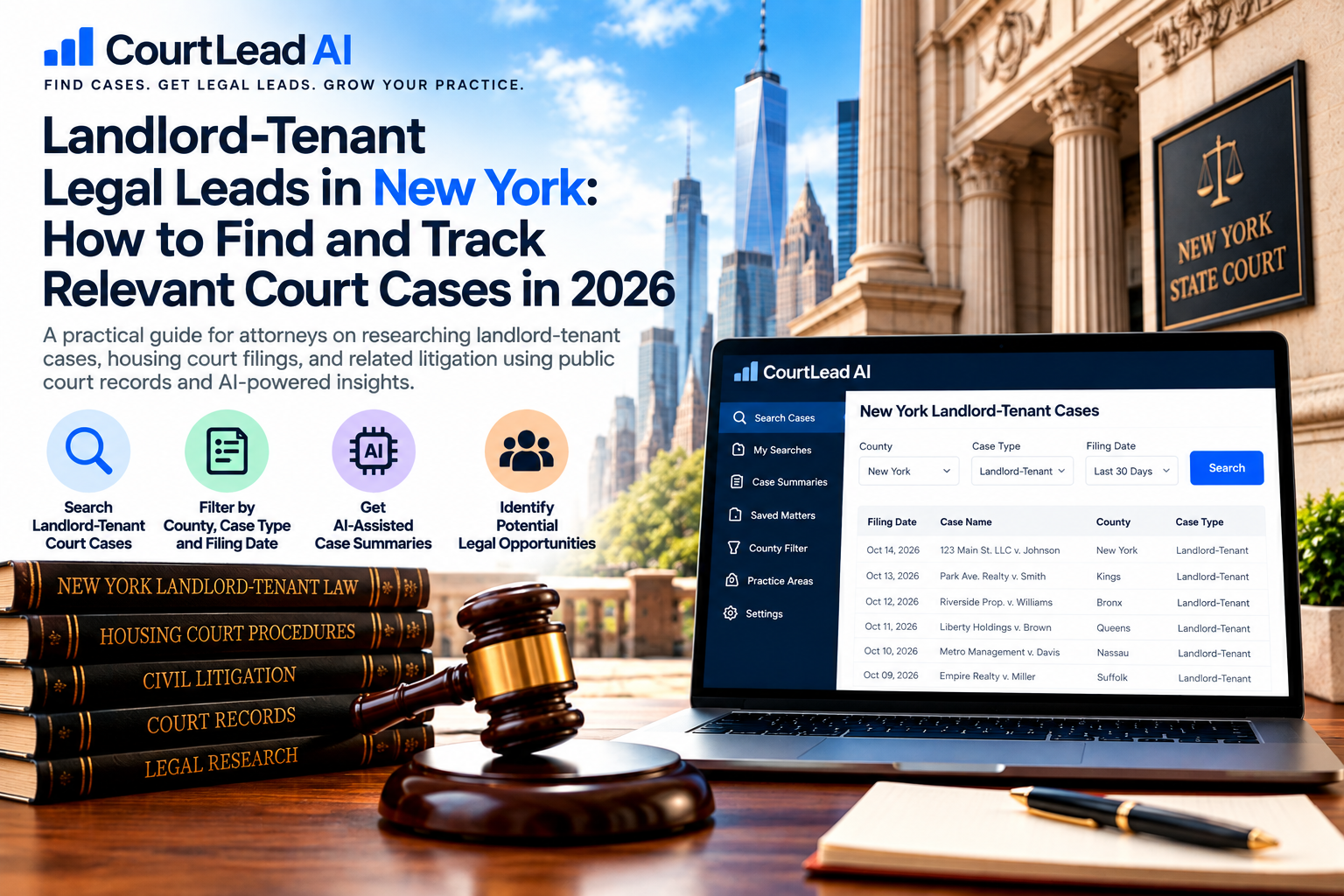
Landlord-Tenant Legal Leads in New York: How Attorneys Can Find and Track Relevant Court Cases in 2026
For New York landlord-tenant attorneys, researching relevant housing disputes is an important part of legal practice, litigation monitoring, and responsible business development.
Landlord-tenant matters can involve nonpayment proceedings, holdover disputes, lease disagreements, possession claims, and other housing-related legal issues. Attorneys representing landlords, tenants, property owners, or property management businesses may need to review public court information as part of their professional work.
However, finding relevant landlord-tenant court cases can be challenging. New York housing litigation spans different courts and jurisdictions, and not every record is publicly accessible or included in every legal research platform.
In 2026, legal technology can support a more organized research process through searchable public records, available case classifications, geographic filters, and AI-assisted preliminary document review.
CourtLead AI helps New York attorneys and law firms research relevant public court cases through selected filters and AI-assisted case information within its supported coverage.
This guide explains how landlord-tenant attorneys can research available court records, understand important case categories, evaluate potential legal opportunities, and select suitable research technology.
What Are Landlord-Tenant Legal Leads?
The term landlord-tenant legal leads is commonly used to describe potential legal business opportunities associated with rental property disputes and housing litigation.
However, an important distinction exists between a public court case and a qualified prospective client.
A landlord-tenant proceeding may identify parties involved in a housing dispute, but it does not establish that either party needs an attorney, is unrepresented, or wishes to obtain legal services.
For responsible research, attorneys should distinguish among:
- Public landlord-tenant records: Court information lawfully available for research.
- Relevant housing disputes: Matters aligned with a law firm's practice and geographic focus.
- Potential legal opportunities: Matters that may warrant further professional evaluation.
- Qualified prospective clients: Individuals or organizations whose interest in legal representation has been appropriately established.
Public court records can support legal research, but they should not automatically be treated as marketing contact lists.
Understanding New York Landlord-Tenant Court Proceedings
New York landlord-tenant litigation can involve different types of proceedings, courts, and procedural rules.
In New York City, many landlord-tenant matters are heard in the Civil Court's Housing Part, commonly called Housing Court. Outside New York City, landlord-tenant proceedings may be handled by other courts with appropriate jurisdiction.
Attorneys should understand which court handles the relevant proceeding before beginning research.
Not every Housing Court record or document is publicly accessible, and availability can differ from the information provided for Supreme Court civil litigation.
Before using a research platform for landlord-tenant matters, attorneys should confirm that it actually supports the relevant court, county, and proceeding type.
Common Types of Landlord-Tenant Cases in New York
1. Nonpayment Proceedings
Nonpayment proceedings generally concern allegations that rent or other legally recoverable amounts remain unpaid.
Attorneys may review available public records to understand the nature of the proceeding, the allegations, and relevant procedural developments.
2. Holdover Proceedings
Holdover proceedings generally involve claims seeking possession of premises based on grounds other than an ordinary nonpayment claim.
The legal issues may depend on the tenancy, applicable housing protections, notices, and the specific allegations.
3. Lease and Rental Agreement Disputes
Some landlord-tenant disputes involve disagreements concerning lease provisions, contractual obligations, or rental arrangements.
Attorneys should review the underlying documents rather than relying entirely on general case descriptions.
4. Commercial Landlord-Tenant Disputes
Commercial property disputes may involve business leases, possession claims, or related contractual issues.
Commercial landlord-tenant matters can differ significantly from residential housing proceedings.
5. Other Housing-Related Litigation
Additional housing matters may concern repairs, housing conditions, property access, or other disputes within the relevant court's jurisdiction.
The correct research approach depends on the type of proceeding and the availability of public information.
Why Landlord-Tenant Attorneys Need Focused Court Research
Attorneys working in housing litigation may serve specific boroughs, counties, or surrounding jurisdictions.
A Manhattan landlord-tenant practice may have different research needs from a firm handling commercial lease disputes in Nassau County.
Focused research helps attorneys concentrate on relevant courts and types of proceedings.
A structured process may support:
- Understanding relevant housing litigation activity.
- Researching selected public proceedings.
- Monitoring available court developments.
- Reviewing relevant legal documents.
- Identifying recurring legal questions.
- Organizing matters for attorney evaluation.
Research relevance is more important than collecting large numbers of unrelated records.
Step 1: Define Your Landlord-Tenant Practice Area
Before researching court cases, attorneys should establish which types of landlord-tenant matters they handle.
For example, a law firm may concentrate on residential tenant representation, landlord representation, commercial leasing disputes, or another specialized area.
Each practice may require different court information.
Important questions include:
- Which landlord-tenant matters does the firm handle?
- Which courts have jurisdiction over those matters?
- Which counties are relevant?
- What public information is available?
- Which documents require attorney review?
Defining these requirements before choosing software can prevent unnecessary research and unsuitable purchases.
Step 2: Identify Relevant New York Courts and Counties
Geographic research is important, but attorneys should also distinguish among the courts handling different categories of housing litigation.
Potential geographic markets include:
- New York County (Manhattan).
- Kings County (Brooklyn).
- Queens County.
- Bronx County.
- Richmond County (Staten Island).
- Nassau County.
- Suffolk County.
For example, a hypothetical attorney focusing on Manhattan residential housing matters should determine which Housing Court records are accessible for the intended research.
A firm handling commercial property disputes may also need to research relevant civil actions in other courts.
County availability alone does not establish that a platform includes Housing Court proceedings.
Step 3: Determine Which Public Landlord-Tenant Records Are Available
Public access to housing-related court information can vary.
Some information may be restricted, incomplete, or unavailable through a particular platform.
Attorneys should verify:
- The court handling the proceeding.
- Whether the relevant case information is publicly accessible.
- Whether documents can be reviewed.
- Whether the research platform includes that court.
- Whether the available information is current.
- Whether privacy or use restrictions apply.
These checks are especially important when evaluating software advertised for New York court case research.
Step 4: Research Relevant Filing Dates and Case Developments
Where available, filing dates can help attorneys organize court research by period.
A firm may choose to examine relevant matters weekly or monthly.
However, a newly filed document is not necessarily the commencement of a new proceeding.
Attorneys should verify the original commencement date and review subsequent procedural developments when relevant.
Researchers should not assume that every housing proceeding is available through the same electronic filing system.
Step 5: Review Available Court Documents
After identifying a relevant proceeding, attorneys should examine the available public information.
Depending on the court and proceeding, accessible materials may include petitions, notices, motions, orders, or other documents.
Important preliminary questions include:
- What type of proceeding is involved?
- Who are the parties identified in the record?
- What relief is requested?
- Which allegations are made?
- What procedural developments are visible?
- Which facts require verification?
Statements in pleadings are allegations, not established findings.
Attorneys must also respect privacy protections and restrictions on the use of housing court information.
Step 6: Use AI-Assisted Summaries Where Supported
AI-assisted summaries can support preliminary review of legal documents when the relevant records are available and the platform supports that function.
For example, automated summaries may help describe:
- The apparent nature of a dispute.
- Principal allegations.
- Requested relief.
- Procedural questions requiring further examination.
- Documents that may deserve attorney attention.
However, AI-generated information may contain mistakes, omissions, or misleading descriptions.
Attorneys should verify material information against original records and should not rely on AI to make legal conclusions.
Step 7: Evaluate Potential Legal Opportunities Responsibly
A public landlord-tenant case does not automatically represent an appropriate business development opportunity.
A landlord or tenant may already have legal representation, may not need additional services, or may be subject to restrictions concerning attorney contact.
Before taking further action, attorneys should consider:
- Practice-area relevance.
- Geographic jurisdiction.
- Available representation information.
- Current procedural status.
- Accuracy and completeness of the record.
- Applicable professional conduct requirements.
- Privacy and restrictions on the use of court information.
Public availability does not automatically authorize targeted solicitation.
How CourtLead AI Can Support Related New York Civil Litigation Research
CourtLead AI is designed to support discovery of relevant public New York court cases using selected research criteria and AI-assisted preliminary information.
Its general research capabilities include:
Public Court Case Discovery
Research available New York civil litigation information within supported courts and case categories.
County-Based Filtering
Focus on geographic jurisdictions aligned with a law firm's practice.
Case-Type Selection
Narrow research to relevant supported civil case classifications.
Filing Date Research
Examine selected periods where filing date filters are available.
AI-Assisted Preliminary Review
Use case summaries where supported to help identify matters requiring closer examination.
Important: Attorneys should confirm whether CourtLead AI currently includes the particular Housing Court, landlord-tenant proceeding, and document types they need. Its general New York civil case research capabilities should not be interpreted as a guarantee of Housing Court coverage.
How to Choose Landlord-Tenant Court Research Software
Before purchasing legal research software for a landlord-tenant practice, attorneys should evaluate the product against specific requirements.
| Evaluation Factor | What Attorneys Should Check |
|---|---|
| Court coverage | Does the platform include the relevant Housing Court or other court? |
| Geographic coverage | Are the required boroughs and counties supported? |
| Proceeding types | Are relevant landlord-tenant categories available? |
| Filing information | Can important dates and case developments be verified? |
| Document access | Which public documents are actually available? |
| AI capabilities | Can supported documents be summarized for preliminary review? |
| Pricing | Do the current subscription terms fit the firm's needs? |
| Professional compliance | Can the platform be used consistently with ethical and privacy obligations? |
Attorneys should confirm actual product capabilities before subscribing.
Example: A Brooklyn Landlord-Tenant Attorney Building a Research Workflow
Consider a hypothetical attorney handling selected landlord-tenant disputes in Brooklyn.
The attorney wants to establish a structured approach to reviewing relevant public proceedings.
First: Identify the Relevant Court
The attorney determines which court handles the type of landlord-tenant matter being researched.
Second: Confirm Public Record Availability
The attorney checks which case information and documents can lawfully be accessed.
Third: Define Relevant Case Categories
The attorney identifies the types of proceedings aligned with the practice.
Fourth: Review Available Records
Relevant public information is examined and important details are verified.
Fifth: Conduct Professional Evaluation
The attorney determines whether additional legal research is warranted and considers applicable ethical requirements.
This example is hypothetical and does not represent a documented CourtLead AI customer result.
How Landlord-Tenant Attorneys Can Improve Their Law Firm Marketing
Legal research is only one component of responsible business development.
Landlord-tenant attorneys can also develop educational content addressing common questions within their practice areas.
Potential website topics include:
- Understanding landlord-tenant proceedings in New York.
- General differences between nonpayment and holdover proceedings.
- Questions tenants may wish to discuss with an attorney.
- Common commercial lease dispute issues.
- What to expect when researching a housing court matter.
- How to prepare for an initial landlord-tenant legal consultation.
Useful educational content can help prospective clients understand legal issues and evaluate whether a law firm's services may be relevant.
Attorneys should avoid misleading claims and comply with applicable professional advertising requirements.
Building a Weekly Landlord-Tenant Research Routine
A consistent research routine can help law firms organize available public information.
Monday: Define Research Priorities
Select relevant courts, jurisdictions, and proceeding types.
Tuesday: Examine Available Public Records
Review information lawfully accessible through the appropriate sources.
Wednesday: Organize Relevant Matters
Identify records requiring additional professional examination.
Thursday: Verify Important Information
Check source documents and available current procedural information.
Friday: Conduct Attorney Review
Evaluate relevant research findings and identify educational topics for the firm's marketing.
This is an illustrative workflow that firms should adapt to their actual needs.
Common Mistakes in Landlord-Tenant Legal Lead Research
1. Assuming All Housing Court Records Are Publicly Available
Access and use restrictions may apply, and record availability differs among courts.
2. Assuming All New York Court Research Platforms Include Housing Court
Attorneys should confirm coverage before selecting a product.
3. Treating Every Housing Dispute as a Qualified Client Lead
A public case does not establish that a party wants or needs additional legal representation.
4. Ignoring Representation Status
Parties may already be represented by attorneys.
5. Relying on Incomplete Case Information
Public records may not include every document or subsequent development.
6. Trusting AI Summaries Without Verification
Automated information should be checked against original documents.
7. Overlooking Privacy and Professional Conduct Requirements
Attorneys must consider restrictions governing the use of housing information and communications with prospective clients.
Frequently Asked Questions About New York Landlord-Tenant Legal Leads
How can New York landlord-tenant attorneys research relevant court cases?
Attorneys can identify the appropriate courts, determine which records are publicly available, and examine relevant proceedings using lawful research methods.
Are all New York Housing Court records publicly accessible?
No. Access and use restrictions may apply, and availability varies depending on the court, record, and applicable rules.
Can attorneys monitor landlord-tenant filings by county?
Research options depend on the court and available information systems. Attorneys should verify which jurisdictions and proceedings a platform supports.
Does CourtLead AI include every New York Housing Court case?
Coverage should not be assumed. Attorneys should confirm CourtLead AI's current supported courts and case classifications before relying on it for landlord-tenant research.
Can AI summarize landlord-tenant court documents?
AI-assisted tools may support preliminary review when relevant documents are available. Material information must be verified against original records.
Does a landlord-tenant lawsuit automatically represent a legal lead?
No. A public proceeding does not establish that a party needs additional representation or may appropriately be contacted.
Can solo attorneys benefit from focused legal research software?
Yes, when a platform's actual court coverage, features, and cost align with the attorney's practice.
Does CourtLead AI guarantee new landlord-tenant clients?
No. CourtLead AI provides legal research technology and does not guarantee client acquisition or legal engagements.
What should attorneys check before buying housing court research software?
Attorneys should verify court coverage, proceeding types, record availability, data accuracy, pricing, privacy restrictions, and professional compliance requirements.
Where can I learn more about CourtLead AI?
Visit the CourtLead AI website to explore its available public court case research capabilities.
Related CourtLead AI Legal Research Resources
Explore additional CourtLead AI articles about New York public court records and legal research:
- How New York Attorneys Can Find Relevant Court Cases and Potential Legal Leads in 2026
- Public Court Records and Legal Research
Connect With CourtLead AI
- Follow CourtLead AI on Facebook
- Connect With CourtLead AI on LinkedIn
- Subscribe to CourtLead AI on YouTube
- Share Your CourtLead AI Experience on Google
Conclusion: Build a More Focused Landlord-Tenant Court Research Strategy
New York landlord-tenant attorneys need accurate, relevant, and lawfully accessible information when researching housing disputes and related litigation matters.
Understanding court jurisdiction, record availability, proceeding classifications, and privacy restrictions is essential before choosing a research method or software platform.
AI-assisted technology can support preliminary review where relevant information is available, but attorneys remain responsible for source verification and professional judgment.
For New York law firms interested in targeted public civil case research, CourtLead AI provides tools designed to support case discovery and preliminary legal opportunity evaluation within its supported coverage.
Find New York Court Cases. Get Legal Leads. Grow Your Practice.
Explore CourtLead AI and Check Its Coverage for Your Practice
Disclaimer: This article is for general informational and marketing purposes only. It does not constitute legal advice. Attorneys should independently verify court information, confirm platform coverage, and comply with applicable professional conduct, advertising, solicitation, privacy, confidentiality, and technology requirements.