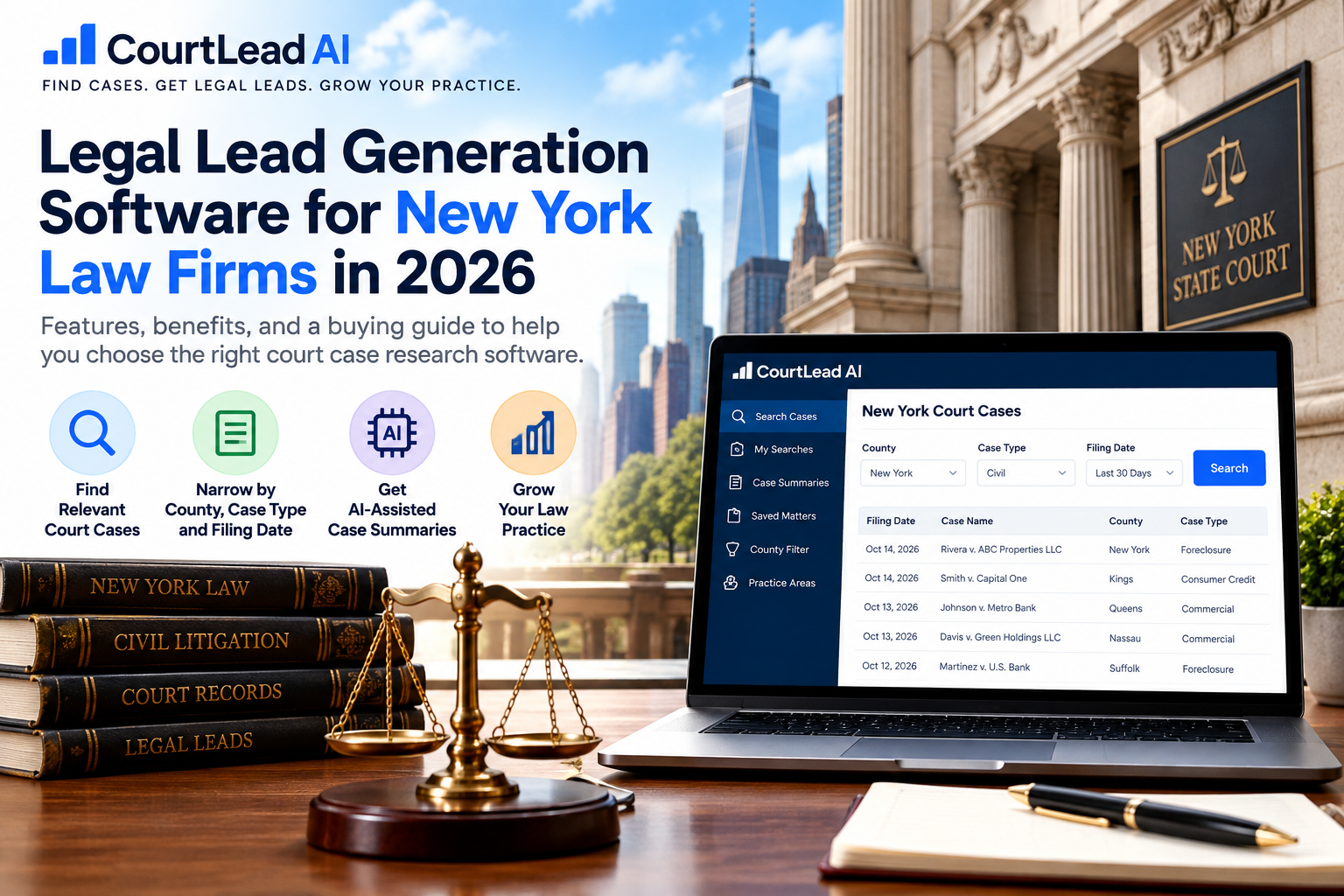
Legal Lead Generation Software for New York Law Firms: 2026 Buying Guide
Finding new business opportunities is an ongoing challenge for New York attorneys and law firms. While professional referrals, search engine visibility, and networking remain important, legal technology can also help firms understand litigation activity and identify relevant matters for further research.
For attorneys evaluating legal lead generation software in 2026, one of the most important considerations is understanding exactly what a platform provides.
Some services focus on marketing inquiries. Others provide public court case research, litigation monitoring, or AI-assisted document review. These tools serve different purposes, and they should not be evaluated as though they deliver identical results.
CourtLead AI is designed to help New York attorneys and law firms discover relevant public court cases, narrow research by selected counties and case types, and review AI-assisted case information.
This buying guide explains the features attorneys should consider, how to compare research tools, and how to determine whether a legal technology platform is suitable for their practice.
What Is Legal Lead Generation Software for Law Firms?
Legal lead generation software is a broad term describing technology used to support law firm business development.
Depending on the product, it may help attorneys attract prospective client inquiries, organize marketing activity, manage contacts, or research potential legal opportunities.
However, a public court case research platform is not necessarily the same as a service that delivers prospective clients who have requested representation.
This distinction matters when comparing software products.
A person named in a court filing may already have counsel, may not need additional legal services, or may not be eligible for targeted attorney solicitation.
Therefore, attorneys should distinguish between public case discovery, potential legal opportunity research, qualified prospective client inquiries, and actual client acquisition.
Why New York Law Firms Are Evaluating Legal Research Technology
New York law firms operate across multiple courts, counties, and civil litigation categories.
A commercial litigation attorney may research business disputes in Manhattan, while a foreclosure practice may focus on selected filings in Nassau or Suffolk County.
Without a defined research process, attorneys may spend considerable time examining records unrelated to their services.
Technology can help organize this work through searchable records, geographic filters, case classifications, and preliminary document summaries.
Potential benefits include:
- More focused public court case research.
- Improved organization of relevant litigation information.
- Reduced attention to unrelated case categories.
- Support for preliminary document review.
- Better alignment between research and practice areas.
- More consistent internal research procedures.
These benefits depend on the platform's actual features, data coverage, accuracy, and suitability for the firm's needs.
1. New York Court Coverage Should Be Your First Consideration
Before selecting legal lead research software, attorneys should understand which courts and jurisdictions the platform covers.
A product advertised for New York legal research may not include every court, case category, or document.
Firms should ask:
- Which New York courts are included?
- Which counties can be searched?
- Are the firm's relevant litigation categories supported?
- Are public documents available for review?
- How are unavailable or incomplete records handled?
Coverage is particularly important for attorneys whose practices concentrate on specific geographic markets.
2. County-Based Filtering for Local Legal Research
New York attorneys often serve particular counties or neighboring jurisdictions.
County-based filtering can help firms focus their research on geographic areas relevant to their services.
Common research markets include:
- New York County (Manhattan).
- Kings County (Brooklyn).
- Queens County.
- Bronx County.
- Nassau County.
- Suffolk County.
For example, a hypothetical commercial litigation firm serving Manhattan and Brooklyn may prioritize relevant New York and Kings County filings.
A law firm serving Long Island may instead concentrate on Nassau and Suffolk Counties.
Geographic filters help attorneys organize research around their actual practice areas rather than collecting unrelated records.
3. Case-Type Filtering for Practice-Specific Research
Legal research becomes more useful when results match the types of cases a firm handles.
When evaluating software, attorneys should determine whether supported case classifications align with their professional experience.
Commercial Litigation
Commercial litigation attorneys may research contract disputes, business disagreements, and other relevant civil proceedings.
Consumer Credit Litigation
Consumer credit practices may examine selected debt collection, credit card, and related financial litigation matters.
Foreclosure Litigation
Foreclosure attorneys may monitor relevant residential mortgage, commercial mortgage, or other foreclosure classifications.
Other Civil Litigation
Law firms handling additional civil matters should verify that the platform supports the categories they need.
A broad database is not automatically more useful than a focused research platform that provides relevant information.
4. Filing Date Research and New Case Monitoring
Some attorneys need historical litigation information, while others prioritize recent filings.
Filing date filters can support research into selected periods and help legal teams establish a consistent monitoring routine.
For example, a firm may review relevant filings weekly rather than conducting occasional unrestricted searches.
However, attorneys must distinguish a newly commenced lawsuit from a newly filed document in an older case.
Important dates and procedural developments should be verified against current official court records.
5. AI-Assisted Case Summaries
AI-assisted summaries are another feature worth evaluating when comparing legal research software.
Public court documents may contain lengthy allegations, procedural information, and supporting materials.
Preliminary AI-assisted summaries can help researchers identify the general nature of a dispute before deciding whether additional examination is warranted.
Potential applications include:
- Identifying the apparent type of litigation.
- Understanding principal allegations described in a filing.
- Recognizing requested relief.
- Preparing questions for further review.
- Determining which documents require attorney attention.
AI-generated information may contain errors, omissions, or misleading descriptions.
Attorneys must verify material details against original court documents and retain responsibility for legal analysis.
6. A Practical Research Workflow
When selecting software, attorneys should consider how easily the platform fits their daily operations.
A useful workflow may involve:
- Selecting relevant New York counties.
- Choosing applicable litigation categories.
- Applying a filing date range.
- Reviewing matching public cases.
- Examining available documents and summaries.
- Verifying important information.
- Referring relevant matters for attorney evaluation.
The goal is to support more organized research, not to replace the attorney's professional responsibilities.
7. Accuracy, Verification, and Data Limitations
Accuracy should be a major consideration when purchasing legal research technology.
Attorneys should not assume that a software result contains every relevant document or reflects the latest procedural developments.
Before selecting a platform, firms should evaluate how information can be checked against official court records.
Important considerations include:
- Availability of source information.
- Clarity of filing dates.
- Identification of courts and counties.
- Completeness of public case records.
- Known limitations in coverage.
- Potential inaccuracies in automated summaries.
Reliable legal research requires both useful technology and careful professional verification.
8. Pricing and Value for Money
Cost is an important consideration for solo attorneys, boutique practices, and larger law firms.
However, the lowest-priced product is not necessarily the best option.
Attorneys should evaluate whether a platform provides features relevant to their actual work.
Before purchasing, consider:
- The current subscription price.
- Any available trial or demonstration options.
- Included features and usage limits.
- Supported courts and case categories.
- Research workflow suitability.
- Contract terms and cancellation policies.
Firms should confirm current pricing and terms directly with the provider rather than relying on outdated comparisons.
9. Legal Research Software for Solo Attorneys
Solo attorneys often manage research, client communication, court work, and business development without dedicated support teams.
For these practices, the value of a research platform may depend on whether it helps organize relevant information without adding unnecessary complexity.
A solo attorney may prioritize:
- Easy-to-use research filters.
- Relevant county coverage.
- Appropriate case classifications.
- Preliminary AI-assisted summaries.
- Manageable subscription costs.
Software should fit the attorney's actual practice rather than encourage unnecessary research activity.
10. Legal Research Software for Small and Mid-Sized Law Firms
Small and mid-sized firms may have multiple attorneys or support staff conducting litigation research.
These firms should consider whether a platform supports consistent research procedures and appropriate professional supervision.
For example, authorized staff may conduct preliminary searches and organize public information, while attorneys verify important records and determine their legal significance.
Firms should also evaluate confidentiality, information security, and technology-use responsibilities.
How CourtLead AI Supports New York Legal Opportunity Research
CourtLead AI is designed for attorneys and law firms researching relevant public New York court cases.
The platform focuses on several practical research capabilities.
Public Court Case Discovery
Research public New York litigation information within the platform's supported coverage.
County-Based Research
Focus on jurisdictions relevant to the firm's geographic market.
Case-Type Selection
Narrow searches to selected civil litigation categories.
Filing Date Research
Examine selected filing periods to support litigation monitoring.
AI-Assisted Preliminary Review
Use case summaries to support initial research before examining source documents.
Potential Legal Opportunity Evaluation
Identify relevant litigation matters for further professional consideration.
CourtLead AI supports legal research and potential opportunity discovery. It does not guarantee prospective clients, legal engagements, or financial results.
Legal Lead Generation Software vs. Traditional Law Firm Marketing
Public court case research technology serves a different purpose from traditional law firm marketing.
| Method | Primary Purpose | Important Consideration |
|---|---|---|
| Professional referrals | Generate introductions through relationships | Requires trust and professional compliance |
| Website SEO | Help prospective clients discover legal services | Requires useful content and ongoing maintenance |
| Paid advertising | Promote legal services to selected audiences | Requires budget management and compliance |
| Public court case research | Identify relevant litigation matters | Does not automatically produce qualified client leads |
| AI-assisted legal research | Support preliminary information review | Requires source verification and attorney oversight |
A law firm may use several of these methods together as part of a broader business development strategy.
How to Compare Legal Lead Generation Software Before Buying
Attorneys can use a simple evaluation framework when comparing products.
Practice Relevance
Does the software support the firm's actual litigation categories?
Geographic Coverage
Does it include the courts and counties relevant to the practice?
Research Quality
Can material information be verified against original records?
Ease of Use
Does the platform support a practical and understandable workflow?
AI Capabilities
Are automated summaries useful for preliminary review, and are their limitations clear?
Pricing
Do the features and current subscription terms fit the firm's budget?
Professional Responsibilities
Can the software be used consistently with applicable confidentiality, supervision, and attorney conduct requirements?
These questions help firms make purchasing decisions based on practical needs rather than unsupported marketing promises.
Example: A Small New York Firm Evaluating Legal Research Software
Consider a hypothetical law firm handling commercial contract disputes in Kings and Queens Counties.
The firm wants to organize research into relevant public civil filings.
Its evaluation process may include:
- Confirming the platform covers relevant courts.
- Checking whether commercial litigation categories are available.
- Testing county and filing date filters.
- Reviewing sample case information.
- Evaluating the usefulness of AI-assisted summaries.
- Verifying information against original documents.
- Comparing subscription costs and terms.
This approach allows the firm to assess the software against its actual workflow.
The example is hypothetical and does not represent a documented customer result or guarantee of business growth.
Ethical Considerations for Legal Lead Research
Attorneys must consider applicable professional conduct rules when using court information for business development.
Relevant responsibilities may include attorney advertising, solicitation, contact with represented persons, confidentiality, and misleading communications.
A public filing does not establish that a party is looking for an attorney or that direct outreach is permissible.
Firms should independently verify relevant information and obtain appropriate professional guidance before conducting targeted communications.
Frequently Asked Questions
What is legal lead generation software for attorneys?
It is technology used to support law firm business development. Depending on the product, it may provide marketing inquiries, contact management, or public court case research.
Can legal lead software help attorneys find New York court cases?
Some platforms, including CourtLead AI, focus on discovering relevant public court cases and supporting preliminary research.
Can law firms search by county and case type?
Yes, where supported by the platform. County and case-type filtering can help narrow research to relevant jurisdictions and litigation categories.
Can AI help review public court filings?
AI-assisted summaries may support preliminary document review. Attorneys must verify important information against original records.
Is legal lead research software useful for solo attorneys?
It may be useful when the available features, geographic coverage, and cost align with the attorney's practice.
Does CourtLead AI guarantee new legal clients?
No. CourtLead AI supports public court case research and potential legal opportunity evaluation. It does not guarantee clients or engagements.
What should attorneys check before purchasing legal research software?
Attorneys should review court coverage, case classifications, available filters, data accuracy, AI limitations, pricing, and professional compliance considerations.
How can I explore CourtLead AI?
Visit the CourtLead AI website to learn more about the platform and its available services.
Related CourtLead AI Articles
Explore additional CourtLead AI resources about New York court research and potential legal opportunity discovery.
- How New York Attorneys Can Find Relevant Court Cases and Potential Legal Leads in 2026
- Public Court Records and Legal Research
Connect With CourtLead AI
Follow CourtLead AI for legal technology insights, public court case research guidance, and platform updates.
- CourtLead AI on Facebook
- CourtLead AI on LinkedIn
- CourtLead AI on YouTube
- Share Your CourtLead AI Experience on Google
Conclusion: Choose Legal Research Software That Supports Your Firm's Goals
Legal lead generation software can support law firm business development, but attorneys should understand the specific purpose of each product before purchasing.
For New York law firms researching public civil litigation, useful capabilities may include county-based filtering, case-type selection, filing date research, and AI-assisted preliminary review.
The most suitable platform is one that aligns with the firm's practice areas, geographic markets, research needs, budget, and professional responsibilities.
CourtLead AI provides a focused approach to public New York court case discovery and preliminary legal opportunity research.
Find New York Court Cases. Get Legal Leads. Grow Your Practice.
Explore CourtLead AI and Evaluate It for Your Law Firm
Disclaimer: This article is for general informational and marketing purposes only. It does not constitute legal advice. Attorneys should independently verify court information and comply with applicable professional conduct, advertising, solicitation, confidentiality, and technology responsibilities.