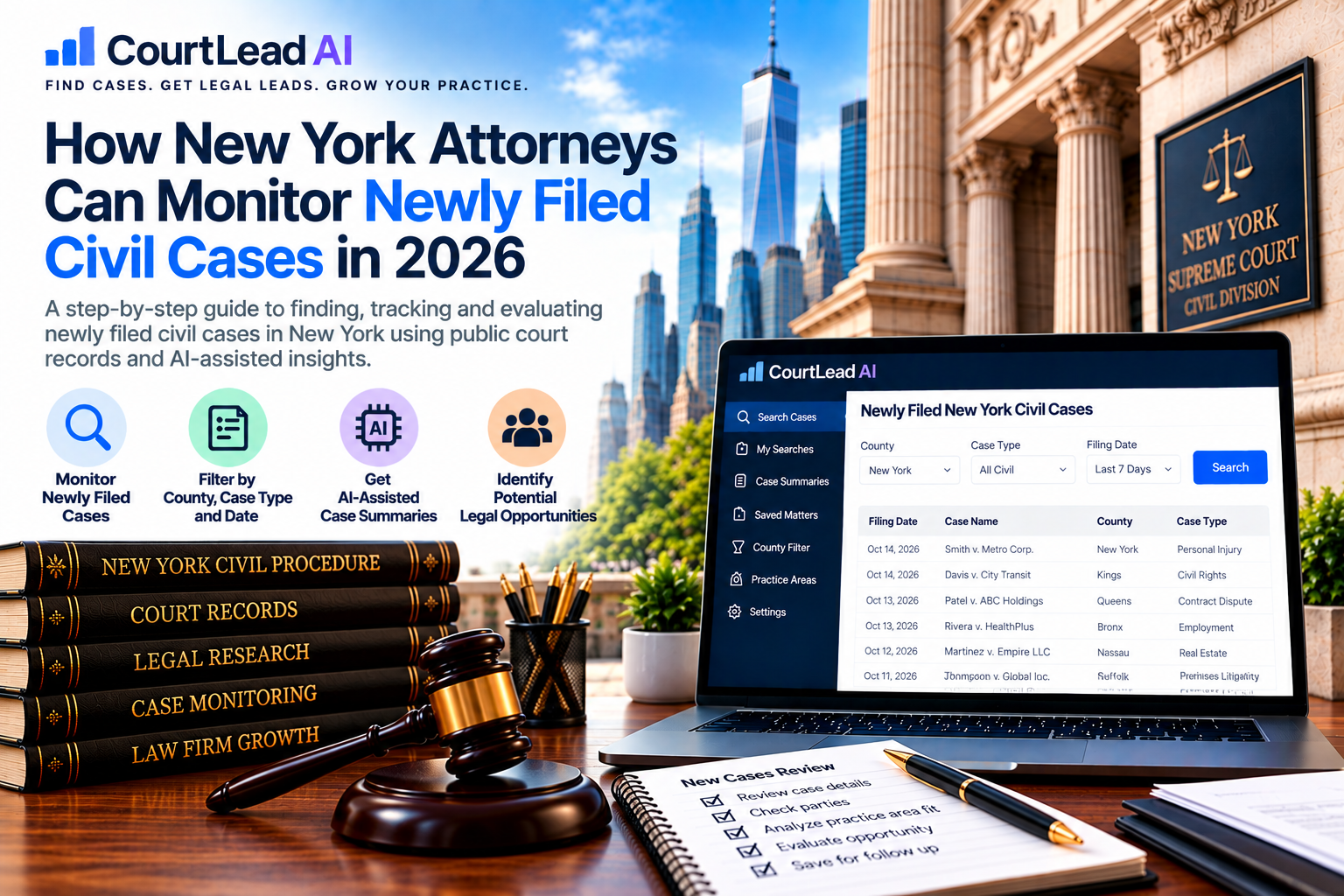
How New York Attorneys Can Monitor Newly Filed Civil Cases in 2026
Every day, new civil matters enter the New York court system. For attorneys and law firms, these filings can provide valuable insight into litigation activity, emerging disputes, and potential legal opportunities.
But finding relevant newly filed cases is not always straightforward. Attorneys may need to review multiple counties, different case categories, filing dates, and supporting documents before determining which matters deserve attention.
In 2026, an organized case monitoring strategy, supported by AI-assisted legal research technology, can help law firms make this process more manageable.
CourtLead AI is designed to help New York attorneys discover relevant public court cases, narrow research using selected criteria, and review AI-assisted case information.
This guide explains how law firms can establish a repeatable process for monitoring newly filed New York civil cases, reduce unnecessary research, and evaluate potential legal opportunities responsibly.
Why Monitoring Newly Filed Civil Cases Matters
Newly filed civil cases offer an early view of litigation activity. Depending on the court, case category, and public access restrictions, records may identify the parties, filing date, court, case classification, and available documents.
For law firms, monitoring this information can support several objectives:
- Understanding current litigation activity in relevant counties.
- Identifying newly filed matters within a firm's practice areas.
- Following developments in selected types of civil disputes.
- Improving internal legal research and business development planning.
- Reducing time spent reviewing unrelated case records.
However, the appearance of a new case does not mean a party is seeking counsel or that contacting that party would be appropriate. Public filings should be treated as research information rather than automatically qualified legal leads.
What Are Newly Filed Civil Cases in New York?
A newly filed civil case is a matter recently commenced in a civil court. Depending on the proceeding, a case may begin with the filing of a summons, complaint, petition, or another initiating document.
New York courts handle a wide range of civil matters, and the filing procedures and available public records differ by court and case type.
Attorneys researching new filings should distinguish between a case's commencement date, the date a particular document was filed, and subsequent docket activity.
This distinction is important because a recent document does not necessarily mean that the underlying lawsuit is new.
Which New York Civil Case Categories Should Attorneys Monitor?
The most useful case categories depend on a firm's experience, services, and geographic market.
Commercial Litigation
Commercial disputes may involve business relationships, contractual obligations, financial disagreements, and other issues between commercial parties.
Law firms concentrating on business litigation may choose to monitor relevant commercial matters in the counties they serve.
Contract Disputes
Contract-related cases can arise from alleged breaches, payment disagreements, performance issues, and other contractual conflicts.
These matters may be relevant to attorneys handling business or civil contract litigation.
Consumer Credit Litigation
Consumer credit proceedings can involve claims related to credit accounts, debt collection, and other consumer financial obligations.
Attorneys working in applicable consumer litigation practice areas may research these filings to understand litigation patterns.
Foreclosure Proceedings
Foreclosure matters may be relevant to attorneys whose practices involve mortgage disputes, foreclosure defense, or related litigation.
Different foreclosure categories can involve different legal issues, so researchers should carefully review the actual case classification and underlying documents.
Other Civil Litigation
Depending on a firm's services, additional categories may include property disputes, certain tort claims, and other civil matters.
The most effective monitoring strategy focuses on cases that align with the firm's professional capabilities rather than attempting to track every filing statewide.
Step 1: Define Your Court Monitoring Criteria
Before beginning a new case search, establish a clear research profile.
At minimum, the profile should identify:
- The law firm's primary practice areas.
- Relevant civil case categories.
- Target New York counties.
- Preferred filing date ranges.
- Types of cases to exclude.
- The purpose of the research.
For example, a hypothetical commercial litigation firm serving Manhattan and Brooklyn might prioritize newly filed commercial and contract-related cases in New York and Kings Counties.
This focused approach can make the resulting case list more useful than an unrestricted search across all civil litigation categories.
Step 2: Monitor the Counties Relevant to Your Practice
New York law firms often serve clients in specific geographic markets.
Common research areas include:
- New York County (Manhattan)
- Kings County (Brooklyn)
- Queens County
- Bronx County
- Nassau County
- Suffolk County
- Other counties relevant to the firm's practice
A firm serving Long Island may place greater emphasis on Nassau and Suffolk Counties, while a practice serving New York City may monitor multiple boroughs.
Researching by county helps attorneys focus on the jurisdictions where their services are most relevant.
Step 3: Use Filing Dates to Find Recent Cases
Filing dates are essential when researching newly commenced matters.
Instead of reviewing a large historical collection of cases, attorneys can establish a defined date range appropriate to their research objectives.
For example, a research team may examine filings from the previous business day, the previous week, or another selected period.
When reviewing results, attorneys should check whether the date refers to the commencement of the case or merely a recent document filed in an existing matter.
They should also account for delays in record availability and differences between court systems.
Step 4: Filter Unrelated Cases Before Detailed Review
One common problem in legal research is spending too much time examining records that do not match the firm's needs.
A structured filtering process can reduce unnecessary work.
Useful criteria may include:
- Court and county.
- Case classification.
- Filing date.
- Available case status information.
- Relevant party or docket details.
Where supported by the research platform, applying these criteria before opening individual documents can help prioritize the most relevant records.
Filtering does not establish whether a matter is legally significant or represents a potential client opportunity. That requires further professional review.
Step 5: Review Important Case Information
Once a relevant filing has been identified, the next step is understanding the available case information.
Researchers should consider reviewing the case title, index number, court, county, filing date, parties, and available public documents.
Depending on the matter, the complaint or initiating filing may provide useful information about the claims and relief requested.
However, allegations in a complaint are not established facts. Researchers should avoid presenting them as proven conclusions.
Step 6: Use AI-Assisted Case Summaries for Preliminary Review
Reading every page of every potentially relevant filing can require substantial staff time.
AI-assisted case summaries can support preliminary review by helping researchers identify the general nature of a matter and information requiring further examination.
For example, a preliminary summary may help an attorney understand:
- The general subject of the litigation.
- The principal allegations described in a filing.
- The type of relief requested.
- Questions requiring additional document review.
AI summaries can be incomplete or inaccurate. Attorneys should verify important information against official documents and should not rely on automated output as a substitute for legal analysis.
Step 7: Verify Case Status and Representation Information
A newly discovered case may change quickly as documents are filed and proceedings develop.
Before making decisions based on a case record, researchers should verify available information against the current official docket.
Relevant checks may include:
- Whether the case is still pending.
- Whether subsequent documents have been filed.
- Whether the original case classification is accurate.
- Whether the parties' representation status can be verified.
- Whether any documents are sealed or otherwise restricted.
These checks are particularly important when case research may inform business development activity.
Step 8: Build a Daily or Weekly Monitoring Routine
A consistent routine helps prevent duplicated work and makes case research easier to manage.
Daily Monitoring
For practice areas where timely research is important, review selected new filings at a consistent interval.
Weekly Review
Examine potentially relevant cases, verify important details, and update internal research notes.
Monthly Analysis
Review patterns across practice areas and counties. Determine whether the research criteria remain aligned with the firm's priorities.
Quarterly Refinement
Assess the usefulness of the monitoring process and adjust categories, counties, and review procedures where appropriate.
Firms should select a schedule that matches their staffing and operational needs.
Step 9: Create a Research Shortlist for Attorney Review
Not every case that matches a search filter deserves detailed analysis.
A research shortlist can help teams distinguish relevant matters from records that require no further action.
A practical internal record may contain:
- Case title and index number.
- Court and county.
- Case category.
- Filing date.
- Reason the case was selected.
- Documents reviewed.
- Verification status.
- Attorney review status.
Research notes should be handled according to the firm's privacy, security, and professional obligations.
How Newly Filed Cases Can Support Law Firm Business Development
New civil filings can provide insight into the kinds of disputes occurring within a firm's market.
For example, a commercial litigation practice might study recurring categories of business disputes and use those insights to improve its educational marketing content.
A firm may decide to publish articles explaining contract litigation, common business dispute procedures, or frequently asked questions about civil litigation.
This approach can help potential clients discover useful information through the firm's website and other professional marketing channels.
Public court records may also identify matters for further internal evaluation, but firms should not assume that parties are unrepresented, need legal services, or may lawfully be solicited.
Responsible Use of Public Court Information
Public access to a court record does not eliminate professional responsibilities.
New York attorneys must consider applicable rules concerning advertising, solicitation, misleading communications, and contact with represented persons.
Before any targeted outreach based on public court information, a firm should verify relevant facts and evaluate whether the proposed communication is permissible.
Ethical compliance should be part of the research workflow, not an afterthought.
How CourtLead AI Supports New York Civil Case Research
CourtLead AI provides legal research technology designed to help New York attorneys and law firms discover relevant public court cases and evaluate potential legal opportunities.
Public Court Case Discovery
Research public New York court case information through a more focused workflow.
County and Practice-Area Filtering
Narrow case research according to relevant geographic areas and case categories.
Filing Date Research
Use filing dates to concentrate on selected periods and recent litigation activity.
AI-Assisted Case Summaries
Review preliminary case information to help identify matters requiring closer examination.
Potential Legal Opportunity Evaluation
Organize relevant case research for further attorney review and responsible business development consideration.
CourtLead AI is a research technology platform. It does not guarantee new clients, legal engagements, case outcomes, or business growth.
Example: Monitoring Commercial Cases in Kings County
Consider a hypothetical law firm focused on commercial litigation in Brooklyn.
The firm decides to monitor selected newly filed commercial and contract-related cases in Kings County.
Its research process includes five stages.
- Define the relevant commercial litigation categories.
- Search a selected filing date range.
- Filter unrelated cases.
- Review available documents and AI-assisted summaries.
- Verify relevant information and refer appropriate matters for attorney evaluation.
The result is a more structured approach to understanding local litigation activity.
This example illustrates a workflow, not a documented customer result or a guarantee of legal leads.
Common Mistakes When Monitoring New York Civil Filings
Monitoring Too Many Case Categories
Overly broad research can overwhelm a legal team with unrelated filings.
Confusing New Documents With New Cases
A recent filing date may refer to a document in an older proceeding.
Ignoring County Relevance
Cases outside the firm's geographic service area may offer limited practical value.
Relying on Unverified Summaries
Automated summaries should not replace examination of underlying court documents.
Assuming Every Filing Represents a Potential Client
A case record alone does not demonstrate demand for legal representation.
Failing to Track Reviewed Cases
Without internal research notes, teams may repeatedly examine the same records.
Frequently Asked Questions
How can attorneys find newly filed civil cases in New York?
Attorneys can research publicly available court records using relevant courts, case categories, counties, and filing dates. Availability varies by court and record type.
Can New York law firms monitor multiple counties?
Yes. Firms can organize research across multiple counties, depending on available records and the capabilities of their research tools.
Which civil case categories are useful for legal lead research?
That depends on the firm's practice. Commercial litigation, contract disputes, consumer credit matters, and foreclosure proceedings are examples of categories that may be relevant to particular firms.
How can AI help with newly filed case research?
AI-assisted summaries can support preliminary review and help researchers identify information requiring closer examination. Material facts must be verified.
Does a new court filing mean someone needs a lawyer?
No. The parties may already be represented or may not need additional legal services.
Can CourtLead AI guarantee new legal leads?
No. CourtLead AI helps attorneys research relevant public cases and evaluate potential legal opportunities. It does not guarantee client acquisition or legal engagements.
How often should a law firm review new court filings?
Some firms may benefit from daily monitoring, while others may find weekly reviews sufficient. The appropriate schedule depends on the practice area and available resources.
Related CourtLead AI Articles
Continue exploring New York court case research and legal opportunity discovery with these CourtLead AI resources.
- How New York Attorneys Can Find Relevant Court Cases and Potential Legal Leads in 2026
- Public Court Records and Legal Research
Explore additional legal research resources and platform information on the CourtLead AI website.
Connect With CourtLead AI
Follow CourtLead AI for legal technology insights, court research guidance, and updates relevant to New York attorneys and law firms.
- CourtLead AI on Facebook
- CourtLead AI on LinkedIn
- CourtLead AI on YouTube
- Review CourtLead AI on Google
Conclusion: Make Newly Filed Court Case Research More Focused
Monitoring newly filed New York civil cases can help attorneys understand current litigation activity and identify matters relevant to their practices.
The most useful research process combines defined practice areas, county-specific searches, filing date filters, careful document review, and independent verification.
AI-assisted technology can make preliminary research easier to organize, but attorney oversight and professional responsibility remain essential.
For law firms seeking a more structured way to research public court filings, CourtLead AI offers tools designed to support case discovery and preliminary evaluation.
Find New York Court Cases. Get Legal Leads. Grow Your Practice.
Disclaimer: This article is provided for general informational and marketing purposes. It does not constitute legal advice. Attorneys should independently verify court information and comply with applicable professional conduct requirements.