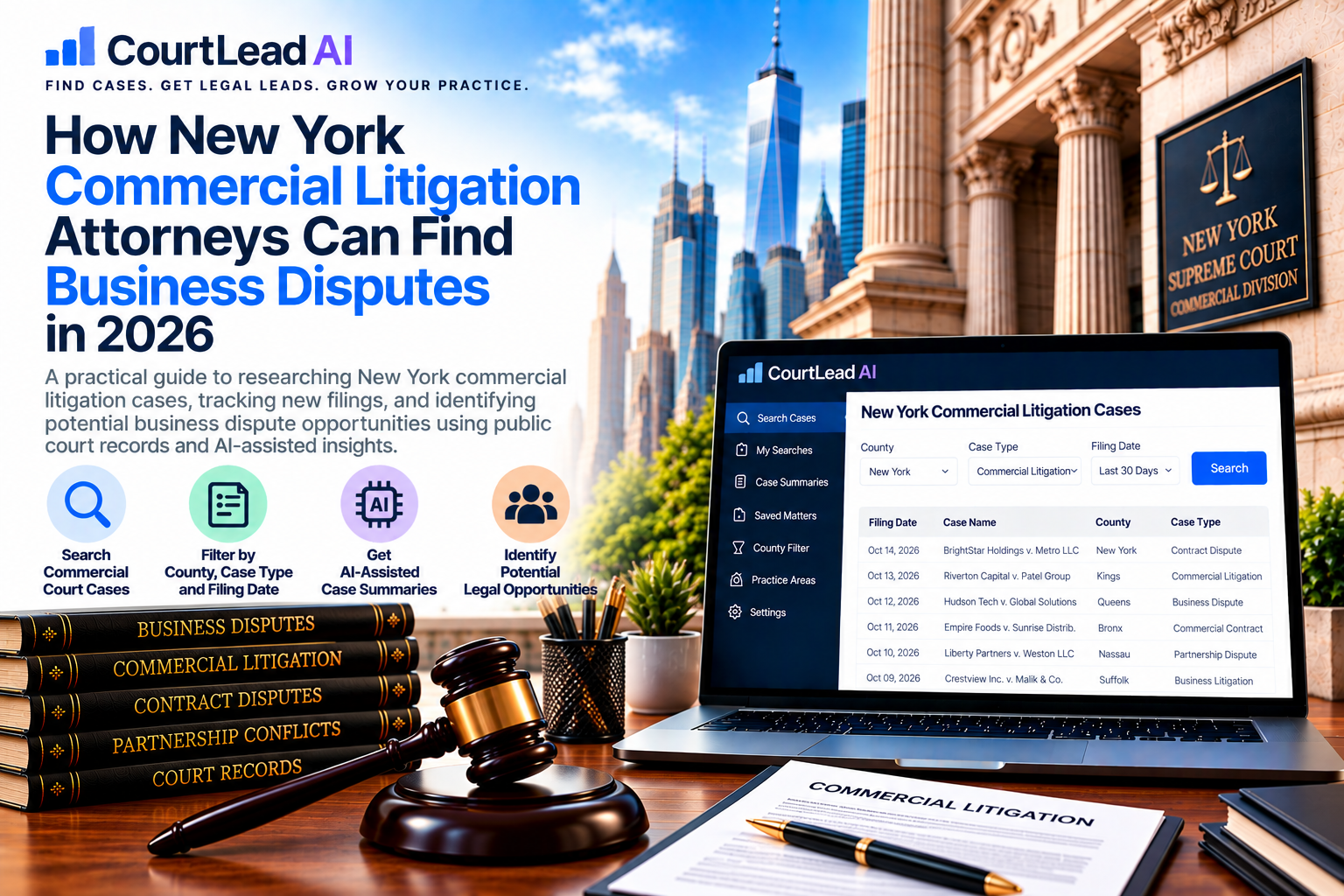
How New York Commercial Litigation Attorneys Can Find Business Disputes in 2026
New York is home to businesses of every size, from small local companies and growing startups to established corporations and major financial organizations. With this commercial activity comes a wide variety of business disputes involving contracts, financial obligations, business relationships, and other legal disagreements.
For commercial litigation attorneys, staying informed about relevant business disputes can support legal research, market awareness, and responsible law firm business development.
However, finding relevant commercial litigation cases across New York courts can be challenging. Attorneys may need to review different case categories, filing dates, counties, and court documents before determining which matters are relevant to their practice.
In 2026, targeted public court case research and AI-assisted legal technology can help make this process more organized.
CourtLead AI helps New York attorneys and law firms discover relevant public court cases, narrow research by selected criteria, and review AI-assisted case information.
This guide explains how commercial litigation attorneys can find relevant business disputes, research newly filed commercial cases, organize litigation information, and identify matters for further professional evaluation.
Why Commercial Litigation Research Matters for New York Law Firms
Commercial litigation involves disputes arising from business activities, commercial relationships, and financial transactions.
These matters may include alleged breaches of contract, disagreements between business partners, disputes over payment obligations, and other commercial claims.
For law firms handling business litigation, public court filings can provide insight into the types of disputes occurring within their target markets.
Depending on the availability of public records, attorneys may be able to review:
- Case titles and index numbers.
- Court and county information.
- Filing dates.
- Commercial case classifications.
- Available complaints and supporting documents.
- Procedural developments.
- Publicly available representation information.
These records can support preliminary legal research and market analysis.
However, a publicly filed business dispute does not automatically indicate that a party is seeking new counsel or represents an appropriate legal lead.
Understanding Common Commercial Litigation Case Types
Commercial litigation covers a broad range of legal disputes. Attorneys should identify which categories align with their firm's professional experience before establishing a research strategy.
Business Contract Disputes
Contract disputes may arise when one party alleges that another failed to fulfill an agreement.
Examples may include disagreements concerning service agreements, vendor contracts, commercial transactions, or other business obligations.
Attorneys handling contractual litigation may choose to monitor relevant public filings within their service areas.
Business Partnership Disputes
Disagreements between business partners, shareholders, or company members can result in litigation involving management decisions, ownership interests, or contractual obligations.
These matters may be relevant to firms concentrating on business and corporate disputes.
Commercial Payment Disputes
Businesses may become involved in litigation concerning alleged unpaid invoices, contractual payment obligations, or other financial disagreements.
Public filings can provide information about the nature of these claims, although allegations should not be treated as established facts.
Commercial Real Estate Disputes
Commercial property disputes may involve leases, contractual obligations, property-related agreements, or other business real estate issues.
Attorneys should distinguish these matters from foreclosure proceedings and other real estate litigation categories.
Other Business Litigation Matters
Additional commercial disputes may involve business transactions, contractual relationships, and other civil claims.
Because commercial litigation is a broad practice area, focused case selection is more useful than searching every available category without clear objectives.
Step 1: Define Your Commercial Litigation Research Priorities
The first step in effective commercial case research is identifying the types of disputes your law firm handles.
For example, a firm specializing in contract litigation may have different priorities from a practice concentrating on shareholder disputes or commercial real estate litigation.
Before conducting searches, establish:
- Primary commercial litigation practice areas.
- Relevant case classifications.
- Target New York counties.
- Preferred filing date ranges.
- Research exclusions.
- Document verification requirements.
- Attorney review procedures.
These criteria can help researchers concentrate on matters that align with the firm's services.
Step 2: Focus on Relevant New York Counties
New York commercial litigation occurs across multiple jurisdictions.
Depending on the firm's practice, relevant research areas may include:
- New York County (Manhattan).
- Kings County (Brooklyn).
- Queens County.
- Bronx County.
- Nassau County.
- Suffolk County.
- Other New York counties served by the firm.
County-specific research helps attorneys focus on the geographic markets relevant to their business development and litigation research objectives.
Example: Manhattan Commercial Litigation Research
Consider a hypothetical law firm that handles commercial contract disputes in Manhattan.
The firm's researchers may prioritize selected commercial case categories in New York County.
They can organize relevant records by filing date, case classification, and document review status.
This creates a focused research process without assuming that every commercial lawsuit represents an available client opportunity.
Step 3: Monitor Newly Filed Commercial Litigation Cases
Newly filed commercial cases can provide timely information about business litigation activity.
A law firm may establish a daily, weekly, or monthly research schedule depending on its staffing and practice needs.
Filing dates should be interpreted carefully.
A newly filed document in an existing lawsuit does not necessarily mean that a new case has been commenced.
Attorneys should verify commencement dates and current docket information before relying on search results.
Step 4: Use Case-Type Filters to Identify Relevant Business Disputes
Broad commercial litigation searches may produce many unrelated cases.
Where supported, useful research filters include:
- County and court.
- Commercial case classification.
- Filing date.
- Available case status information.
- Relevant party or docket details.
For example, a firm focusing on contract litigation may prioritize relevant contractual disputes rather than reviewing unrelated civil proceedings.
Filtering helps organize research but does not establish the legal significance of any particular case.
Step 5: Review Commercial Litigation Documents
Once a relevant business dispute has been identified, attorneys should examine the available public court documents.
Depending on the proceeding, these may include complaints, summonses, motions, exhibits, orders, and other filings.
Preliminary research may consider:
- The general nature of the business dispute.
- The parties involved.
- The contractual or commercial issues described.
- The relief requested.
- The procedural stage.
- Relevant subsequent filings.
Claims made in pleadings are allegations and should not be presented as proven facts without appropriate verification.
Attorneys should also consider confidentiality, privacy, and any restrictions affecting access to particular documents.
Step 6: Use AI-Assisted Summaries to Support Case Review
Commercial litigation documents can be lengthy and may involve complex contractual or financial issues.
AI-assisted summaries can support preliminary review by helping researchers understand the general nature of a case and identify questions requiring closer examination.
For example, a preliminary summary may help identify:
- The apparent type of commercial dispute.
- The principal allegations described in a complaint.
- The relief requested.
- Important procedural questions.
- Documents requiring additional review.
AI-generated information can contain mistakes or omit relevant context.
Attorneys should independently verify material details against the underlying court documents and exercise professional legal judgment.
Step 7: Verify Current Case Status and Representation
Commercial litigation can develop through additional pleadings, motions, orders, settlement-related proceedings, and other procedural events.
Before relying on a case record, researchers should verify the current available docket information.
Important questions include:
- Is the case still pending?
- Have important documents been filed since commencement?
- Does the case classification accurately describe the dispute?
- Is representation information available and current?
- Are any relevant documents restricted from public access?
These checks are especially important when research may inform business development decisions.
Step 8: Distinguish Relevant Business Disputes From Qualified Legal Leads
A commercial lawsuit may align with a law firm's practice without representing an appropriate prospective client opportunity.
For example:
- A business may already have legal representation.
- The dispute may fall outside the firm's professional experience.
- The matter may have been resolved or substantially changed.
- The available public information may be incomplete.
- Applicable professional rules may restrict communications.
For these reasons, public commercial case discovery should be treated as an initial research step.
Any proposed business development action should receive appropriate attorney review.
Step 9: Follow Attorney Advertising and Solicitation Requirements
Public court records can be useful for legal market research, but their use in targeted marketing requires care.
New York attorneys must consider applicable professional conduct rules concerning advertising, solicitation, misleading communications, and contact with represented persons.
The existence of a public business dispute does not automatically authorize direct outreach to the parties involved.
Law firms should verify relevant facts and evaluate applicable ethical requirements before considering any targeted communication.
How CourtLead AI Supports Commercial Litigation Research
CourtLead AI is designed to help New York attorneys and law firms discover relevant public court cases and organize preliminary legal research.
Targeted Public Court Case Discovery
Focus on public New York court cases relevant to selected commercial litigation practice areas.
County and Case-Type Filtering
Narrow research to selected geographic areas and litigation categories.
Filing Date Research
Review selected filing periods to support litigation monitoring.
AI-Assisted Case Summaries
Use preliminary case information to identify matters requiring further professional review.
Potential Legal Opportunity Discovery
Organize relevant public case information for responsible business development evaluation.
CourtLead AI provides research technology and does not guarantee legal clients, engagements, or litigation outcomes.
Example: A Brooklyn Law Firm Researching Contract Disputes
Consider a hypothetical law firm focused on commercial contract litigation in Brooklyn.
The firm decides to monitor selected business dispute categories in Kings County.
Its research team follows a structured process:
- Define relevant commercial and contract litigation categories.
- Select Kings County as the primary research location.
- Review cases within a selected filing date range.
- Examine available public case information.
- Use AI-assisted summaries for preliminary review.
- Verify important details against official court records.
- Refer appropriate matters for attorney evaluation.
This process can help the firm organize its litigation research and understand relevant business dispute activity.
The example is hypothetical and does not represent a documented customer result or guarantee that new clients will be acquired.
Building a Weekly Commercial Litigation Research Workflow
Law firms can benefit from establishing a consistent research routine.
Monday: Search Recent Commercial Filings
Review selected counties and commercial litigation categories.
Tuesday: Filter Relevant Matters
Remove unrelated results and create a preliminary shortlist.
Wednesday: Review Documents
Examine public pleadings and supporting materials, using AI-assisted summaries where appropriate.
Thursday: Verify Case Details
Confirm important information against current court records.
Friday: Attorney Evaluation
Refer relevant matters for professional review and update internal research notes.
This schedule is illustrative and can be adjusted to match the firm's resources.
How Commercial Litigation Research Can Improve Law Firm Marketing
Public business dispute research can also help law firms understand recurring legal issues within their target markets.
For example, a firm may identify common questions involving contract disputes, business disagreements, or commercial litigation procedures.
These insights can inform educational website articles, frequently asked questions, and other informational marketing materials.
Educational content can help potential clients understand the firm's services without relying on inappropriate targeted solicitation.
Marketing materials should remain accurate, professional, and consistent with applicable attorney advertising rules.
Common Commercial Litigation Research Mistakes
Searching Without a Defined Practice Focus
Broad research can overwhelm legal teams with unrelated cases.
Ignoring Geographic Relevance
Cases outside the firm's service area may have limited practical value.
Confusing New Documents With New Lawsuits
A recent docket entry does not necessarily indicate a newly commenced case.
Assuming Allegations Are Established Facts
Statements in complaints and other pleadings may be disputed.
Relying Entirely on AI Summaries
Automated summaries should be checked against original documents.
Assuming Every Business Dispute Is a Legal Lead
A public case does not establish that a party is seeking new representation.
Frequently Asked Questions
How can New York commercial litigation attorneys find relevant court cases?
Attorneys can research publicly available court records using relevant counties, commercial case classifications, and filing date ranges, subject to record availability.
What types of business disputes appear in commercial litigation?
Commercial litigation can involve contract disputes, business relationship disagreements, payment claims, and other business-related civil matters.
Can attorneys monitor newly filed commercial cases?
Yes. Where public records and search capabilities permit, attorneys can review selected filing periods to monitor recent commercial litigation activity.
Why are county filters important?
County filters help law firms focus on jurisdictions relevant to their geographic service areas.
How can AI assist with commercial litigation research?
AI-assisted summaries can support preliminary review and help identify information requiring further examination. Material facts must be independently verified.
Does a commercial lawsuit mean a business needs a new attorney?
No. A business may already have counsel or may not need additional legal services.
Can CourtLead AI guarantee commercial litigation clients?
No. CourtLead AI supports public court case research and potential legal opportunity discovery. It does not guarantee clients or legal engagements.
Is CourtLead AI a commercial litigation law firm?
No. CourtLead AI is a legal technology platform and does not provide legal representation or legal advice.
Related CourtLead AI Articles
Explore additional CourtLead AI resources about public court records and legal opportunity discovery:
- How New York Attorneys Can Find Relevant Court Cases and Potential Legal Leads in 2026
- Public Court Records and Legal Research
Visit the CourtLead AI website for more information about our legal research platform.
Connect With CourtLead AI
Follow CourtLead AI for legal technology insights, public court case research guidance, and updates for New York attorneys and law firms.
- Follow CourtLead AI on Facebook
- Connect With CourtLead AI on LinkedIn
- Subscribe to CourtLead AI on YouTube
- Share Your CourtLead AI Experience on Google
Conclusion: Build a More Focused Commercial Litigation Research Strategy
Commercial litigation filings can provide useful information for New York attorneys seeking to understand business dispute activity and identify matters relevant to their practice.
An effective research process begins with clearly defined case categories, selected counties, filing date filters, and careful document verification.
AI-assisted technology can support preliminary review, but professional legal judgment and responsible use of public information remain essential.
For New York commercial litigation attorneys seeking a more organized approach to public court case research, CourtLead AI offers technology designed to support case discovery and preliminary evaluation.
Find New York Court Cases. Get Legal Leads. Grow Your Practice.
Disclaimer: This article is for general informational and marketing purposes only. It does not constitute legal advice. Attorneys should independently verify court information and comply with applicable professional conduct requirements.