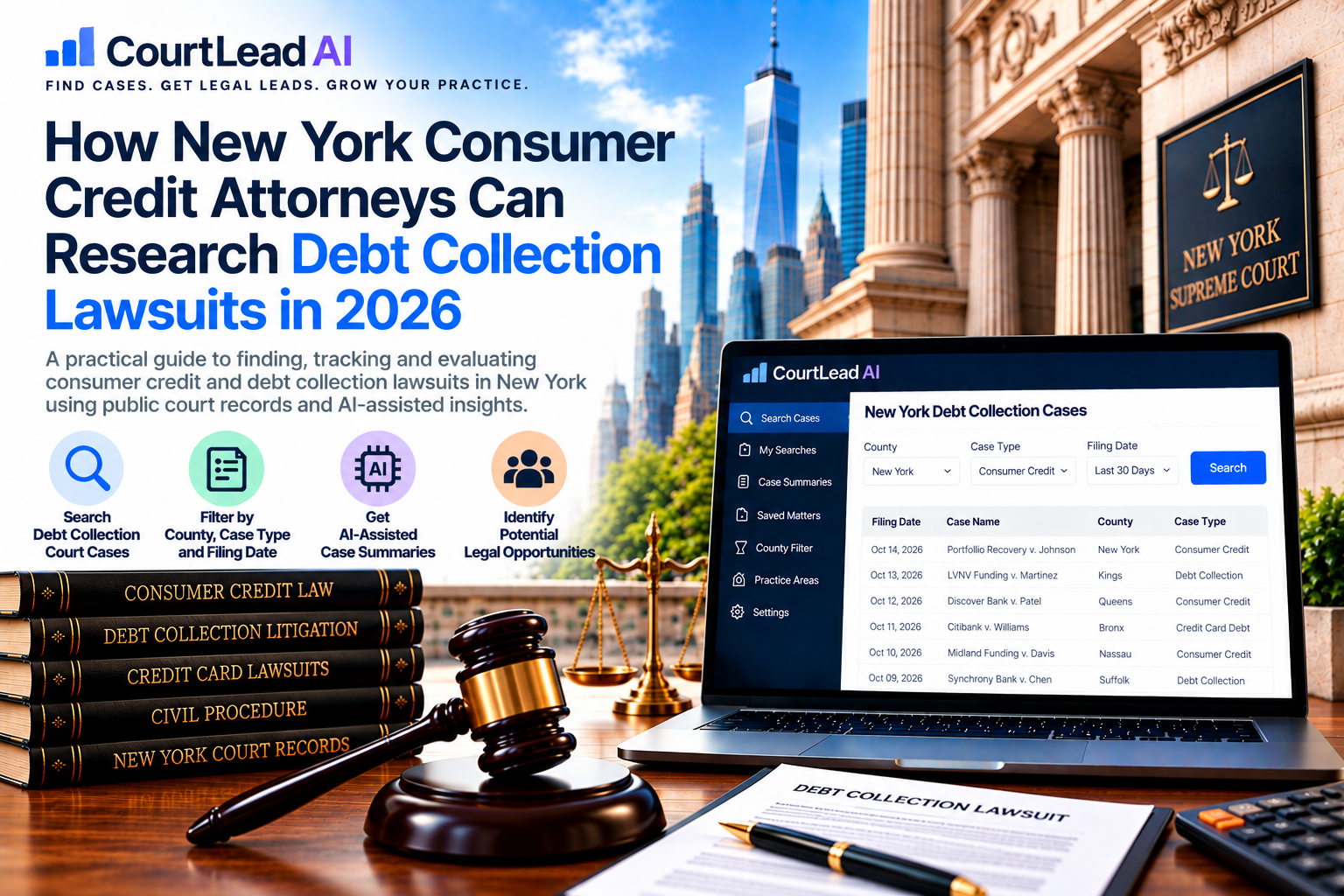
How New York Consumer Credit Attorneys Can Research Debt Collection Lawsuits in 2026
Consumer credit litigation is an important area of civil legal practice in New York. Debt collection lawsuits, credit card disputes, claims involving debt buyers, and other consumer financial matters can generate substantial volumes of court records across different jurisdictions.
For attorneys and law firms representing creditors, debt buyers, or consumers, finding relevant litigation information can be a valuable part of legal research, market analysis, and responsible business development.
However, reviewing consumer credit filings manually presents several challenges. Attorneys must distinguish between different plaintiff categories, examine case classifications, verify filing dates, and review available court documents before determining whether a matter is relevant to their practice.
In 2026, a more focused research process supported by AI-assisted legal technology can help attorneys organize these tasks.
CourtLead AI helps New York attorneys and law firms discover relevant public court cases, narrow research by county and case category, and review AI-assisted case information.
This guide explains how consumer credit attorneys can build a structured court case research strategy, understand important debt collection lawsuit categories, and identify matters for further professional evaluation.
What Is Consumer Credit Litigation in New York?
Consumer credit litigation generally involves legal disputes arising from consumer borrowing, credit accounts, or related financial obligations.
Depending on the underlying facts, proceedings may concern credit card accounts, personal loans, purchased debts, or other consumer financial transactions.
These cases can involve different types of plaintiffs, defendants, financial institutions, and debt purchasers.
For law firms, understanding the differences between case categories is important because not every consumer credit lawsuit involves the same legal issues or research objectives.
Why Consumer Credit Court Records Matter to Attorneys
Public consumer credit court records can provide insight into the types of litigation occurring in a particular jurisdiction.
Depending on public access and the court involved, researchers may be able to examine:
- Case titles and index numbers.
- Court and county information.
- Filing dates.
- Available case classifications.
- Publicly accessible pleadings.
- Procedural developments.
- Available representation information.
These details can support litigation monitoring and preliminary case research.
However, a court filing does not establish that the allegations are true or that any party is seeking legal representation.
Understanding Different Consumer Credit Case Categories
Consumer credit litigation may appear under several case classifications. Attorneys should understand what those classifications generally describe before setting their research criteria.
Consumer Credit Card Litigation
Credit card litigation may involve claims arising from allegedly unpaid credit card obligations.
These matters can involve original creditors, debt buyers, or other entities claiming a legal right to recover a debt.
Attorneys should review the available filing documents rather than relying on the category name alone.
Original Creditor Plaintiff Cases
An original creditor plaintiff is generally the lender or creditor associated with the original account or obligation.
Researching these matters may be relevant to attorneys whose practices involve creditor representation, consumer litigation, or related disputes.
Debt Buyer Plaintiff Cases
A debt buyer generally acquires debt obligations from another entity and may bring collection litigation based on claimed ownership of the debt.
These cases may raise questions about assignment documentation, ownership, account records, and other matters requiring professional legal analysis.
Researchers should not assume that every claim made by a debt buyer has been established merely because a lawsuit was filed.
Secondary Debt Buyer Cases
Some debt obligations may be transferred more than once.
Cases involving subsequent debt purchasers can present additional questions about the history of the claimed obligation and supporting documentation.
Attorneys researching these matters should examine the actual filings and avoid relying exclusively on automated case labels.
Non-Card Consumer Credit Matters
Consumer credit litigation can also involve obligations other than credit cards, depending on the applicable court classification.
Attorneys should determine whether these matters align with their specific practice areas and research objectives.
Step 1: Define Your Consumer Credit Research Strategy
Effective consumer credit case research begins with a clear understanding of the firm's legal services.
A law firm representing consumers may have different research priorities from a firm representing financial institutions or debt purchasers.
Before beginning a search, establish the following criteria:
- Relevant consumer credit case categories.
- Whether the research concerns creditor or debtor-side litigation.
- Target New York counties.
- Selected filing date ranges.
- Available court and case status information.
- Research exclusions.
- Internal attorney review requirements.
Defining these criteria helps avoid unnecessary review of cases outside the firm's professional focus.
Step 2: Focus on Relevant New York Courts and Counties
Consumer credit litigation may be handled in different courts depending on the nature of the claim, jurisdictional requirements, and other factors.
Law firms should identify the courts and counties relevant to their services rather than assuming that every consumer credit matter appears in New York Supreme Court.
Potential geographic research areas include:
- New York County.
- Kings County.
- Queens County.
- Bronx County.
- Nassau County.
- Suffolk County.
- Other counties relevant to the firm's practice.
Public record availability and search capabilities vary by court. A research process should account for these differences.
Example: A Queens County Consumer Litigation Practice
Consider a hypothetical law firm representing consumers in selected credit-related disputes.
The firm may concentrate on relevant public consumer credit cases in Queens County and other jurisdictions within its service area.
Its researchers can organize available records by case category, filing date, and verification status.
This approach helps the team understand litigation activity without assuming that every defendant is an appropriate prospective client.
Step 3: Identify Newly Filed Debt Collection Lawsuits
Filing dates can help attorneys monitor recent consumer credit litigation activity.
A firm may establish a daily, weekly, or monthly research schedule depending on its resources and objectives.
However, researchers should distinguish between the date a lawsuit was commenced and the date a later document was filed.
A recently filed motion or other document does not necessarily mean that the underlying case is new.
Important dates should be verified against the official docket and available records.
Step 4: Apply Case-Type Filters to Reduce Unrelated Results
Consumer credit searches can become difficult to manage when researchers examine every available category without narrowing their focus.
Where supported, useful filters may include:
- County and court.
- Consumer credit case classification.
- Filing date.
- Available case status information.
- Relevant party or case details.
For example, an attorney researching original creditor litigation may wish to distinguish those matters from cases involving debt buyer plaintiffs.
Filtering can improve research organization, but attorneys should verify the actual nature of each case before relying on the classification.
Step 5: Review Important Debt Collection Case Documents
Once a potentially relevant case is identified, the next step is reviewing the available public documents.
Depending on the proceeding, these may include a summons, complaint, supporting exhibits, motions, orders, or other docket materials.
A preliminary review should consider:
- The nature of the claim.
- The identity and roles of the parties.
- The amount claimed, where relevant and publicly available.
- The relief requested.
- The procedural stage.
- Any important subsequent docket activity.
Statements contained in pleadings are allegations and should not be treated as proven facts without appropriate verification.
Researchers should also minimize unnecessary collection or sharing of personal financial information.
Step 6: Use AI-Assisted Case Summaries Carefully
Debt collection lawsuits may contain documents that require detailed review, particularly when the underlying account history or ownership of a claimed debt is disputed.
AI-assisted summaries can support preliminary research by identifying the general nature of a case and highlighting questions requiring further examination.
For example, an AI-assisted review may help a researcher identify:
- The apparent consumer credit case category.
- The principal allegations in a complaint.
- The type of relief requested.
- References to supporting documents.
- Issues requiring additional attorney review.
AI-generated summaries can contain factual mistakes or omit relevant context.
Attorneys must verify material details against the underlying court documents and exercise independent professional judgment.
Step 7: Verify Representation and Current Case Status
Before considering a consumer credit matter for further evaluation, researchers should verify available case status and representation information.
A defendant may already have counsel. A matter may have been resolved, dismissed, or otherwise changed since its initial filing.
Important verification questions include:
- Is the case still pending?
- Have additional documents been filed?
- Does the case classification match the underlying claim?
- Is representation information available and current?
- Are any records sealed or restricted?
These checks help prevent inaccurate assumptions about the case or the individuals involved.
Step 8: Distinguish Relevant Cases From Potential Legal Leads
A relevant consumer credit lawsuit is not automatically a qualified legal lead.
A party named in a public filing may already be represented, may not need additional services, or may be subject to restrictions on attorney contact.
For this reason, law firms should use a separate professional review process before deciding whether a matter warrants further business development consideration.
Relevant questions include whether the case aligns with the firm's services, whether information has been verified, and whether any proposed communication would comply with applicable professional conduct requirements.
Step 9: Follow New York Attorney Advertising and Solicitation Rules
Consumer credit litigation often involves financially sensitive circumstances.
Attorneys should take particular care when using public case information for marketing or direct communications.
New York professional conduct requirements may govern attorney advertising, solicitation, misleading statements, and communications with represented persons.
The fact that a person's name appears in a public debt collection filing does not automatically permit an attorney to contact that individual for business development purposes.
Law firms should evaluate current rules and obtain appropriate ethics guidance before initiating targeted outreach.
How CourtLead AI Supports Consumer Credit Case Research
CourtLead AI is a legal technology platform designed to help New York attorneys and law firms discover relevant public court cases and organize preliminary research.
Targeted Court Case Discovery
Focus on public New York court cases that align with selected research priorities.
County and Case-Type Filtering
Narrow research to relevant geographic areas and litigation categories.
Filing Date Research
Review selected filing periods to support litigation monitoring.
AI-Assisted Case Summaries
Use preliminary summaries to identify information requiring closer examination while independently verifying important facts.
Potential Legal Opportunity Research
Identify relevant matters for professional evaluation without treating every filing as a prospective client.
CourtLead AI supports legal research and does not guarantee new clients, legal engagements, or litigation outcomes.
Building a Weekly Consumer Credit Research Workflow
A repeatable workflow can help attorneys and legal support teams maintain consistent research standards.
Monday: Identify Relevant New Filings
Search selected courts, counties, and consumer credit categories.
Tuesday: Filter and Organize Results
Remove unrelated cases and create a preliminary research shortlist.
Wednesday: Review Public Documents
Examine available pleadings and supporting materials, using AI-assisted summaries where appropriate.
Thursday: Verify Case Information
Confirm material details and current docket information.
Friday: Attorney Evaluation
Refer relevant matters for professional review and update internal research records.
This schedule is illustrative and can be adjusted to match a firm's staffing and workload.
Using Consumer Credit Research to Improve Law Firm Marketing
Public litigation research can also help attorneys understand recurring legal issues within their market.
For example, consumer litigation attorneys may identify common questions about debt collection lawsuits, responding to complaints, or understanding court procedures.
These topics can inform educational website articles, frequently asked questions, and other informational marketing materials.
Educational content allows firms to explain their services and legal practice areas without assuming that particular individuals are available for direct solicitation.
Any marketing material should be accurate, avoid misleading claims, and comply with applicable professional rules.
Example: A New York Law Firm Researching Debt Buyer Cases
Consider a hypothetical law firm that focuses on selected consumer credit litigation matters.
The firm wants to better understand publicly filed cases involving debt buyer plaintiffs in its service area.
Its research team establishes the following process:
- Select relevant consumer credit case categories.
- Identify the counties and courts to research.
- Review a defined filing date range.
- Examine available public case information.
- Verify important details against current court records.
- Refer appropriate matters for attorney evaluation.
This workflow can help organize litigation research and support market analysis.
It is a hypothetical illustration, not a documented client result or guarantee that the firm will acquire new business.
Common Mistakes in Consumer Credit Case Research
Confusing Original Creditors and Debt Buyers
Different plaintiff categories may involve different factual and legal issues.
Assuming All Consumer Credit Cases Are Credit Card Cases
Consumer credit litigation can involve multiple types of financial obligations.
Ignoring Court Jurisdiction
Relevant matters may appear in different courts depending on the claim and applicable jurisdictional rules.
Relying on Outdated Case Information
Case status can change after the initial filing.
Treating Allegations as Established Facts
A complaint presents claims that may be disputed.
Using AI Summaries Without Verification
Automated information should be checked against original records.
Assuming Every Defendant Is a Potential Client
A public filing does not establish a need for representation or permission to contact a party.
Frequently Asked Questions
What is a consumer credit lawsuit in New York?
Consumer credit litigation generally involves disputes arising from consumer borrowing, credit accounts, or related financial obligations.
Can attorneys research debt collection lawsuits online?
Many court records are publicly accessible online, although availability varies by court, proceeding, and access restrictions.
What is the difference between an original creditor and a debt buyer?
An original creditor is generally associated with the original credit obligation, while a debt buyer acquires debt claims from another entity.
Can law firms research consumer credit cases by county?
Yes. Where available, county-based research helps attorneys focus on jurisdictions relevant to their practice.
How can AI assist with debt collection case research?
AI-assisted summaries can support preliminary review and help identify information requiring further examination. Important details must be verified.
Does a debt collection lawsuit mean the defendant needs a lawyer?
No. A filing alone does not establish whether the defendant needs legal services, already has counsel, or may appropriately be contacted.
Can CourtLead AI guarantee consumer credit clients?
No. CourtLead AI provides research technology and does not guarantee legal clients or engagements.
Is CourtLead AI a debt collection law firm?
No. CourtLead AI is a legal technology platform, not a law firm, and does not provide legal representation or legal advice.
Related CourtLead AI Articles
Explore more CourtLead AI resources about New York court research and potential legal opportunity discovery:
- How New York Attorneys Can Find Relevant Court Cases and Potential Legal Leads in 2026
- Public Court Records and Legal Research
Visit the CourtLead AI website to explore our platform and additional legal research resources.
Connect With CourtLead AI
Follow CourtLead AI for legal technology insights, court case research guidance, and updates for New York attorneys and law firms.
- Follow CourtLead AI on Facebook
- Connect With CourtLead AI on LinkedIn
- Subscribe to CourtLead AI on YouTube
- Share Your CourtLead AI Experience on Google
Conclusion: Build a More Focused Consumer Credit Litigation Research Strategy
Consumer credit and debt collection lawsuits can provide useful information for New York attorneys seeking to understand litigation activity and identify matters relevant to their practice.
Effective research begins with clearly defined case categories, relevant courts and counties, appropriate filing date ranges, and careful document verification.
AI-assisted technology can support preliminary case review, but professional legal judgment and responsible use of public information remain essential.
For New York attorneys seeking a more organized way to research public court cases, CourtLead AI offers technology designed to support case discovery and preliminary evaluation.
Find New York Court Cases. Get Legal Leads. Grow Your Practice.
Disclaimer: This article is for general informational and marketing purposes only. It does not constitute legal advice. Attorneys should independently verify court information and comply with applicable professional conduct requirements.