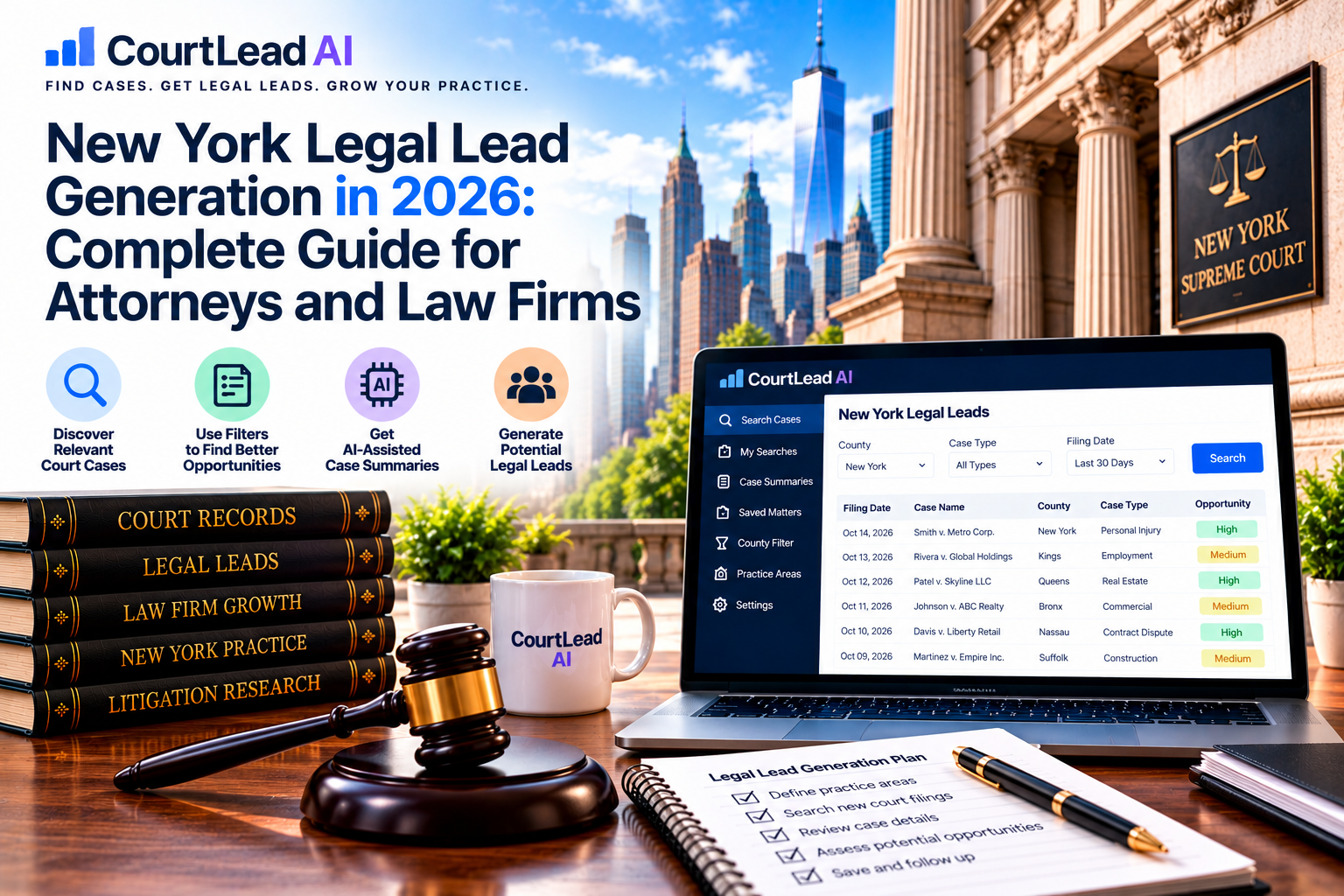
New York Legal Lead Generation in 2026: Complete Guide for Attorneys and Law Firms
Growing a law firm in New York requires more than excellent legal knowledge. Attorneys must also build professional relationships, develop a credible online presence, understand their target markets, and create consistent opportunities for prospective clients to discover their services.
For solo attorneys, boutique practices, and established law firms, legal lead generation can be one of the most challenging aspects of business development.
Traditional approaches such as professional referrals, networking, search engine optimization, and advertising remain relevant. However, attorneys can also use publicly available court information to understand litigation activity and identify matters that may warrant further professional research.
In 2026, AI-assisted legal technology can help organize this research by supporting targeted court case discovery, preliminary document review, and structured evaluation.
CourtLead AI helps New York attorneys and law firms discover relevant public court cases, apply selected research filters, and review AI-assisted case information.
This comprehensive guide explains how New York legal lead generation works, how public court records fit into a broader business development strategy, and how attorneys can use research technology responsibly.
What Is Legal Lead Generation for New York Attorneys?
Legal lead generation is the process of attracting or identifying potential opportunities for new attorney-client relationships.
A traditional legal lead may begin when someone contacts a law firm through its website, telephone number, referral network, or another permissible marketing channel.
However, not every source of legal market information represents a qualified lead.
For example, a public court filing may reveal that litigation exists, but it does not establish that a party needs representation, is looking for a new attorney, or may lawfully be contacted.
Attorneys should therefore distinguish between:
- Legal market research: Understanding litigation activity, practice-area demand, and recurring legal issues.
- Potential legal opportunity research: Identifying relevant matters that may warrant additional professional evaluation.
- Qualified prospective client inquiries: Genuine expressions of interest from individuals or organizations seeking legal services.
- Client acquisition: Establishing an attorney-client relationship after appropriate evaluation and engagement procedures.
These stages serve different purposes and should not be treated as interchangeable.
Why Legal Lead Generation Matters in 2026
New York attorneys operate in a competitive professional environment. Prospective clients have multiple ways to discover legal services, compare firms, and evaluate their options.
For law firms, an effective business development strategy should create opportunities for appropriate client inquiries while supporting long-term credibility.
Important objectives may include:
- Increasing awareness of the firm's services.
- Reaching relevant geographic markets.
- Building professional credibility.
- Explaining specialized practice areas.
- Improving the quality of prospective client inquiries.
- Understanding local litigation activity.
- Making better use of available research and marketing resources.
Technology can support these objectives, but it does not eliminate the importance of professional reputation, legal experience, and ethical compliance.
The Main Legal Lead Generation Strategies for New York Law Firms
There is no single marketing method that guarantees new clients.
A balanced strategy usually combines several complementary activities.
1. Professional Referrals
Referrals from existing clients and professional relationships can introduce attorneys to people who may need legal assistance.
Law firms should maintain appropriate professional standards and comply with applicable rules governing referrals and recommendations.
2. Search Engine Optimization
Search engine optimization helps law firm websites become more discoverable for relevant legal information and services.
Useful content may explain practice areas, common legal questions, and the geographic locations served by the firm.
3. Educational Legal Content
Articles, frequently asked questions, and educational videos can help prospective clients understand legal issues and the services a firm provides.
Content should be accurate, useful, and consistent with applicable attorney advertising requirements.
4. Local Business Visibility
Accurate business information and a professional local online presence can help prospective clients identify firms serving their communities.
5. Professional Networking
Networking with other legal professionals and relevant business communities can support long-term relationships and professional visibility.
6. Public Court Case Research
Public court filings can provide information about litigation activity within selected practice areas and jurisdictions.
Attorneys may use these records to support legal research, market analysis, and appropriate professional opportunity evaluation.
7. AI-Assisted Legal Research
AI-assisted technology can support preliminary document review and help attorneys organize information from selected court records.
Important facts and legal conclusions must still be independently verified.
How Public Court Records Support Legal Opportunity Research
Public court records can be a useful source of information for attorneys researching litigation activity in New York.
Depending on the court and applicable access restrictions, records may include:
- Case titles.
- Index or docket numbers.
- Filing dates.
- Court and county information.
- Case classifications.
- Publicly available pleadings.
- Orders and other docket developments.
- Available attorney representation information.
These records may help attorneys identify cases relevant to their professional interests.
However, public availability does not establish that the information is complete, current, or suitable for targeted marketing.
Attorneys should independently verify important details and consider applicable professional responsibilities.
Step 1: Define Your Law Firm's Target Practice Areas
Effective court case research begins with a clear understanding of the firm's services.
Attorneys should avoid searching every available civil case without establishing a research objective.
Instead, identify the litigation categories most relevant to the practice.
Commercial Litigation
Commercial litigation attorneys may research business contract disputes, payment disagreements, and other commercial civil matters.
Consumer Credit Litigation
Consumer credit practices may research selected debt collection lawsuits, credit card disputes, and other relevant financial litigation categories.
Foreclosure Litigation
Foreclosure attorneys may monitor selected residential mortgage, commercial mortgage, and other foreclosure-related proceedings.
Other Civil Litigation
Firms handling other civil disputes should establish research criteria based on their professional experience and services.
Practice-area targeting helps reduce unrelated results and makes the research process more manageable.
Step 2: Choose Relevant New York Counties
Geographic targeting is another important component of effective legal research.
New York law firms may serve specific counties, neighboring jurisdictions, or broader regions.
Common research locations include:
- New York County (Manhattan).
- Kings County (Brooklyn).
- Queens County.
- Bronx County.
- Nassau County.
- Suffolk County.
- Other counties relevant to the firm's services.
For example, a hypothetical firm serving Nassau and Suffolk Counties may focus its public case research on those jurisdictions.
Another firm concentrating on commercial litigation in Manhattan may prioritize relevant New York County filings.
County selection should reflect actual practice needs rather than assumptions about which location will produce the most clients.
Step 3: Monitor Newly Filed Court Cases
Filing dates can help attorneys organize research into recent litigation activity.
Depending on the firm's resources, researchers may examine selected filings daily, weekly, or monthly.
However, attorneys should distinguish between the commencement of a new lawsuit and the filing of an additional document in an existing case.
A recently filed motion does not necessarily indicate that the underlying proceeding is new.
Researchers should verify commencement dates and relevant procedural developments against the current official docket.
Step 4: Use Case-Type and Date Filters to Improve Research Relevance
Broad searches can produce large numbers of unrelated records.
Where supported, combining several research criteria may improve relevance.
Useful criteria include:
- Court and county.
- Case classification.
- Selected filing date range.
- Available case status information.
- Relevant party or docket details.
For example, a firm handling commercial contract disputes may focus on selected commercial litigation categories within its preferred counties.
Filtering helps organize preliminary research but does not determine the merits or business development value of a case.
Step 5: Review Available Court Documents
After identifying a relevant case, attorneys should examine the available public documents.
Depending on the proceeding, these may include complaints, petitions, motions, exhibits, orders, and other filings.
Important questions include:
- What type of dispute is described?
- Who are the parties?
- What allegations are made?
- What relief is requested?
- What procedural developments are visible?
- Which details require further verification?
Statements in pleadings are allegations and should not be treated as established facts without appropriate verification.
Attorneys should also respect applicable privacy and access restrictions.
Step 6: Use AI-Assisted Case Summaries Responsibly
Legal documents can be lengthy and complex. AI-assisted summaries may help researchers obtain a preliminary overview before deciding which records require closer examination.
Depending on the available source material, a summary may help describe:
- The general nature of the dispute.
- The principal allegations.
- The relief requested.
- Important questions for further review.
- Documents requiring attorney attention.
However, AI-generated information may contain factual mistakes, omit relevant context, or misunderstand procedural details.
Attorneys must independently verify material information against the original documents.
AI should support professional research rather than replace legal judgment.
Step 7: Evaluate Potential Legal Opportunities
A relevant public court case is not automatically a qualified prospective client.
Before determining whether a matter warrants further professional attention, attorneys should consider:
- Practice-area relevance.
- Geographic and jurisdictional relevance.
- Current procedural status.
- Available representation information.
- Accuracy and completeness of the records.
- Applicable professional conduct requirements.
A party may already have legal representation or may not need additional services.
The existence of a lawsuit does not automatically authorize targeted solicitation.
Step 8: Build a Repeatable Legal Research Workflow
Consistency can make court case research easier to manage.
A law firm may establish a weekly workflow that separates case discovery, document review, verification, and attorney evaluation.
Monday: Identify Relevant Filings
Search selected courts, counties, and case categories.
Tuesday: Organize Research Results
Remove unrelated records and create a preliminary shortlist.
Wednesday: Review Case Information
Examine public documents and AI-assisted summaries where appropriate.
Thursday: Verify Important Details
Check material information against official court records.
Friday: Conduct Attorney Evaluation
Determine which matters warrant further research and identify broader market insights.
This schedule is illustrative and should be adjusted to the firm's staffing and workload.
How CourtLead AI Supports New York Legal Lead Research
CourtLead AI is designed to help New York attorneys and law firms discover relevant public court cases and organize preliminary research.
The platform brings together several capabilities that can support a more focused research process.
Public Court Case Discovery
Research relevant public New York court case information within the platform's supported coverage.
County-Based Filtering
Focus on geographic jurisdictions aligned with the firm's practice.
Case-Type Selection
Narrow research to relevant civil litigation categories.
Filing Date Research
Review selected filing periods to support litigation monitoring.
AI-Assisted Case Summaries
Use preliminary case descriptions to identify matters requiring closer examination.
Potential Legal Opportunity Research
Organize relevant public case information for responsible professional evaluation.
CourtLead AI provides legal research technology. It does not guarantee new clients, engagements, financial returns, or litigation outcomes.
Legal Lead Generation for Solo Attorneys
Solo attorneys often manage both legal work and business development without dedicated marketing teams.
A focused strategy may help make better use of limited time.
Practical priorities include:
- Concentrating on established practice areas.
- Targeting relevant counties.
- Maintaining an informative website.
- Building appropriate professional relationships.
- Creating educational legal content.
- Conducting structured public case research.
- Evaluating technology costs and usefulness.
Solo attorneys should avoid assuming that a larger volume of court records will automatically generate more clients.
Research quality and appropriate professional evaluation are more meaningful than raw search volume.
Legal Lead Generation for Small and Boutique Law Firms
Small law firms may benefit from clearly assigning responsibilities for research, verification, marketing, and attorney review.
For example, authorized support staff may organize public case information while attorneys determine the legal significance of the records.
A consistent workflow can help reduce duplicated effort and maintain better internal research records.
Firms should establish appropriate supervision, confidentiality, and technology-use policies.
Legal Lead Generation for Established Law Firms
Larger law firms may have multiple practice groups and broader geographic coverage.
These firms can organize public case research by department, jurisdiction, or litigation category.
For example, commercial litigation researchers may focus on selected business disputes while another team monitors relevant foreclosure or consumer credit matters.
Regardless of firm size, research findings should be verified and evaluated by qualified professionals.
How Court Case Research Can Support Law Firm SEO
Public litigation research can help attorneys understand recurring legal questions within their practice areas.
These insights may inform useful website articles, practice-area explanations, and frequently asked questions.
For example:
- A commercial litigation practice may publish educational content about contract disputes.
- A consumer credit attorney may explain general procedures in debt collection litigation.
- A foreclosure-focused firm may discuss common questions about foreclosure proceedings.
- A county-focused practice may publish useful information about civil litigation within its service area.
Effective SEO content should answer real questions accurately rather than simply repeat keywords.
Attorneys should avoid unsupported claims, misleading advertising, and unnecessary disclosure of information about parties in specific lawsuits.
Creating a Professional Law Firm Online Presence
A credible online presence helps prospective clients understand a firm's services and decide whether to make an inquiry.
Important elements include:
- A professional website.
- Clear practice-area descriptions.
- Accurate contact information.
- Relevant geographic service details.
- Educational articles.
- Appropriate attorney biographies.
- Clear consultation or inquiry instructions.
Law firms should ensure that their marketing complies with applicable professional conduct requirements.
Public court research can complement this strategy by providing general insight into litigation topics, but it should not replace a credible and informative online presence.
Using AI Research and Human Judgment Together
AI-assisted legal research is most useful when its role is clearly defined.
Technology may support initial information processing, while attorneys remain responsible for verification and professional decisions.
| Research Activity | Technology Can Support | Attorney Responsibility |
|---|---|---|
| Case discovery | Searching and filtering relevant records | Defining appropriate research criteria |
| Preliminary review | Summarizing available case information | Checking accuracy and context |
| Document analysis | Organizing information for examination | Interpreting legal significance |
| Opportunity evaluation | Supporting research organization | Assessing suitability and ethical requirements |
| Client engagement | Not a substitute for professional procedures | Managing communications and representation decisions |
Law firms should not delegate legal conclusions or professional responsibilities to automated systems.
Measuring the Effectiveness of Legal Lead Generation
A law firm should evaluate marketing performance using meaningful measures rather than relying on impressions or the number of court records collected.
Potential measurements include:
- Genuine prospective client inquiries.
- Inquiry sources.
- Consultations requested and completed.
- Matters accepted after appropriate review.
- Marketing expenditures.
- Time spent on research.
- Research relevance and accuracy.
- Educational content engagement.
Attorneys should distinguish research activity from actual client acquisition.
A large number of relevant filings does not necessarily translate into new legal engagements.
Common Legal Lead Generation Mistakes
1. Treating Every Court Filing as a Client Lead
Public litigation information is not equivalent to a prospective client inquiry.
2. Searching Without a Defined Practice Area
Broad research can produce unrelated results and unnecessary work.
3. Ignoring Geographic Relevance
Research should reflect the firm's service area and professional capabilities.
4. Relying on Outdated Case Information
Procedural developments may change after the initial filing.
5. Trusting AI Summaries Without Verification
Automated output can contain errors and omissions.
6. Overlooking Representation Status
A party may already have legal counsel.
7. Ignoring Professional Conduct Rules
Public records do not automatically authorize direct solicitation.
8. Depending on Only One Marketing Channel
A balanced strategy can combine professional relationships, educational content, appropriate advertising, and legal research.
9. Focusing Only on Research Volume
Research quality matters more than the number of records collected.
10. Failing to Measure Business Results
Without basic performance tracking, firms may struggle to determine which activities deserve continued investment.
A Practical 30-Day Legal Research and Marketing Plan
New York attorneys interested in building a more structured approach can begin with a manageable 30-day plan.
Week 1: Establish Your Research Focus
- Identify primary practice areas.
- Select relevant New York counties.
- Define case-type and filing-date criteria.
- Review existing marketing channels.
Week 2: Begin Targeted Court Research
- Research selected public case categories.
- Organize preliminary findings.
- Review available case information.
- Verify important details.
Week 3: Develop Educational Marketing Content
- Identify recurring general legal questions.
- Create useful practice-area content.
- Improve website service descriptions.
- Review local business information for accuracy.
Week 4: Evaluate and Improve
- Review research relevance.
- Assess time spent on document review.
- Evaluate genuine prospective client inquiries.
- Identify workflow improvements.
- Adjust the next month's research priorities.
This plan is illustrative and does not guarantee new clients or measurable financial results.
Legal Ethics, Privacy, and Responsible Business Development
Legal lead generation must be consistent with applicable professional responsibilities.
New York attorneys should consider rules governing advertising, solicitation, misleading communications, confidentiality, privacy, and contact with represented persons.
Using public court information for research does not automatically make targeted outreach permissible.
Attorneys should verify relevant facts, review applicable requirements, and obtain appropriate ethics guidance before undertaking communications based on specific litigation records.
Law firms using AI tools should also understand how those systems process information and should maintain appropriate confidentiality and supervision safeguards.
The Future of AI-Assisted Legal Research for New York Law Firms
AI-assisted technology is creating additional possibilities for organizing legal information and supporting preliminary document review.
For law firms, the practical value lies in using technology to assist with defined research tasks while preserving professional accountability.
As these tools evolve, attorneys should continue evaluating their accuracy, security, limitations, and suitability for legal work.
Responsible adoption requires a balance between efficiency and careful verification.
The strongest research workflow is not necessarily the most automated one. It is the process that produces relevant, reliable information while respecting professional obligations.
Frequently Asked Questions About New York Legal Lead Generation
What is legal lead generation for attorneys?
Legal lead generation involves attracting or identifying potential opportunities for new attorney-client relationships through appropriate marketing, referrals, and other professional business development activities.
Can New York attorneys research public court cases for business development?
Public court records may support legal market research and potential opportunity evaluation, subject to access restrictions and applicable professional conduct requirements.
Can public court filings identify qualified prospective clients?
Not automatically. A filing does not establish that a party needs representation, is interested in legal services, or may appropriately be contacted.
How can AI assist with legal case research?
AI-assisted summaries can support preliminary document review and help identify information requiring closer examination. Material details must be verified against source documents.
Which New York counties can attorneys research?
Attorneys may research relevant public records in counties such as New York, Kings, Queens, Bronx, Nassau, Suffolk, and other jurisdictions, depending on record availability and research needs.
Is legal lead generation suitable for solo attorneys?
Yes. Solo attorneys can develop focused business development strategies using professional referrals, educational content, local visibility, and responsible public court research.
Can law firms monitor newly filed civil cases?
Yes, where public record coverage and research tools permit. Filing dates and current procedural information should be independently verified.
Does CourtLead AI provide legal representation?
No. CourtLead AI is a legal technology platform and does not provide legal representation or legal advice.
Does CourtLead AI guarantee new legal clients?
No. CourtLead AI supports public court case discovery and preliminary legal opportunity research. It does not guarantee client acquisition or business results.
What is the best way to start a legal lead research strategy?
Begin with a defined practice area, relevant geographic markets, selected case categories, a manageable research schedule, and a clear process for verifying information and obtaining attorney review.
Explore More CourtLead AI Legal Research Resources
Continue learning about New York court case research and potential legal opportunity discovery through these CourtLead AI articles:
- How New York Attorneys Can Find Relevant Court Cases and Potential Legal Leads in 2026
- Public Court Records and Legal Research
Visit the CourtLead AI website to explore our legal research platform and additional resources.
Connect With CourtLead AI
Follow CourtLead AI for updates about legal technology, New York court case research, AI-assisted document review, and responsible law firm business development.
- Follow CourtLead AI on Facebook
- Connect With CourtLead AI on LinkedIn
- Subscribe to CourtLead AI on YouTube
- Share Your CourtLead AI Experience on Google
Conclusion: Build a Smarter New York Legal Lead Generation Strategy in 2026
Effective legal lead generation requires a combination of professional credibility, useful marketing, targeted research, and responsible evaluation.
For New York attorneys and law firms, public court filings can provide valuable information about litigation activity across relevant practice areas and geographic markets.
AI-assisted research tools can support preliminary case review and help legal teams organize information, but they must be used alongside independent verification and professional judgment.
The objective is not to collect the largest possible number of court records. It is to build a reliable process for understanding relevant litigation activity, identifying matters for appropriate evaluation, and supporting sustainable law firm business development.
For attorneys seeking a more focused way to discover and research public New York court cases, CourtLead AI provides technology designed to support case discovery and preliminary legal opportunity evaluation.
Find New York Court Cases. Get Legal Leads. Grow Your Practice.
Disclaimer: This article is for general informational and marketing purposes only. It does not constitute legal advice. Attorneys should independently verify court information and comply with applicable professional conduct, advertising, solicitation, confidentiality, privacy, and technology responsibilities.