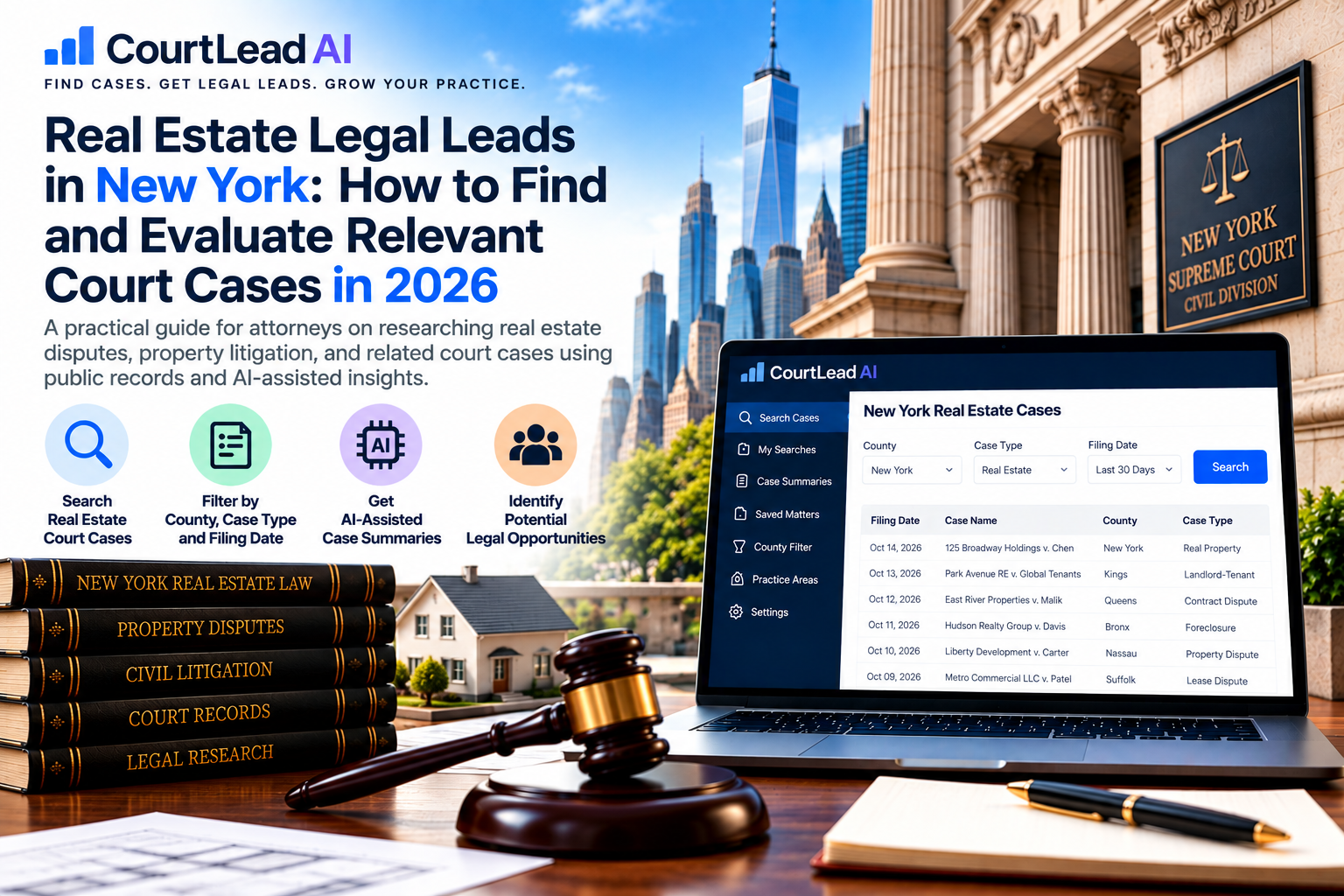
Real Estate Legal Leads in New York: How Attorneys Can Find and Evaluate Relevant Court Cases in 2026
New York real estate litigation involves a wide range of disputes concerning residential property, commercial buildings, real estate contracts, ownership rights, and property-related financial obligations.
For attorneys and law firms handling these matters, researching public court filings can support litigation monitoring, market intelligence, legal analysis, and responsible business development.
However, identifying relevant real estate lawsuits across New York's counties can require considerable research. A broad civil court search may produce many cases unrelated to a firm's practice, while individual pleadings may contain complex allegations requiring careful review.
In 2026, targeted court case research software can help attorneys organize this process through county-based filtering, selected litigation categories, filing date searches, and AI-assisted preliminary case summaries.
CourtLead AI is designed to help New York attorneys and law firms discover relevant public court cases and evaluate potential legal opportunities within its supported coverage.
This guide explains how real estate litigation attorneys can research relevant public filings, understand property-related case categories, evaluate legal research software, and establish a more focused case discovery strategy.
What Are Real Estate Legal Leads?
The term real estate legal leads is often used to describe potential legal business opportunities associated with property transactions, disputes, and litigation.
These opportunities may arise through professional referrals, website inquiries, existing client relationships, or other appropriate business development channels.
Public court records can also help attorneys identify real estate litigation matters relevant to their practices.
However, a publicly filed lawsuit is not automatically a qualified legal lead.
A property owner, business, tenant, lender, or other party named in litigation may already have legal counsel or may not be seeking additional representation.
Attorneys should distinguish between:
- Public real estate court records: Available information about property-related litigation.
- Relevant property disputes: Cases matching a firm's practice areas and jurisdictions.
- Potential legal opportunities: Matters that may warrant additional professional examination.
- Qualified prospective clients: People or organizations whose interest in legal services has been appropriately established.
This distinction is important when evaluating court case research tools and planning law firm marketing activities.
Why New York Real Estate Attorneys Need Targeted Court Case Research
Real estate litigation can involve different courts, counties, and categories of legal disputes.
A commercial real estate attorney researching business property conflicts in Manhattan may have different needs from a property litigation attorney handling title disputes on Long Island.
Without clear research criteria, law firms may spend time reviewing matters that do not match their services.
A structured research process can help attorneys:
- Identify relevant public real estate litigation filings.
- Concentrate on counties where the firm practices.
- Review selected property-related case categories.
- Research recent filing activity.
- Examine available pleadings and court documents.
- Organize matters requiring additional attorney review.
- Understand general litigation activity within their markets.
The objective is to improve research relevance and organization, not simply to collect more case records.
Common Types of New York Real Estate Litigation
Real estate disputes are not limited to one type of lawsuit.
Attorneys should understand the different categories of property-related litigation before selecting search filters or evaluating research software.
1. Real Estate Contract Disputes
Real estate contract disputes may arise when parties disagree about the terms, performance, or enforcement of an agreement involving property.
Examples may include disagreements concerning purchase agreements, contractual obligations, deposits, or other transaction-related issues.
Attorneys should review the available pleadings to determine the specific allegations and relief requested.
2. Commercial Real Estate Litigation
Commercial property disputes may involve businesses, investors, developers, property owners, or other entities.
These matters can concern contractual relationships, property rights, financial obligations, or disagreements associated with commercial developments.
Commercial real estate litigation attorneys may research these proceedings where they align with their professional experience.
3. Property Ownership and Title Disputes
Some real estate lawsuits involve disagreements concerning ownership interests, title, or competing claims to property.
Depending on the proceeding, attorneys may encounter allegations involving title defects, disputed transfers, or other ownership-related issues.
These cases can require detailed examination of public documents and property-related records.
4. Partition Actions
Partition proceedings may arise when co-owners disagree about their interests in property or seek judicial relief concerning jointly owned real estate.
Attorneys researching partition matters should review the available complaint, requested relief, and procedural developments.
5. Foreclosure-Related Property Litigation
Foreclosure proceedings can involve mortgage enforcement and other property-related financial disputes.
Because foreclosure is a specialized practice area, attorneys should select the relevant classifications carefully rather than treating every real estate case as a foreclosure matter.
6. Commercial Lease Disputes
Commercial lease litigation may concern rent obligations, contractual terms, possession issues, or other disputes involving commercial premises.
These matters should be distinguished from residential Housing Court proceedings, which may be handled in different courts and may have different record availability.
7. Other Real Property Disputes
Additional cases may involve easements, boundaries, property-related agreements, or other civil claims.
Attorneys should determine relevance from the underlying documents rather than relying exclusively on broad case classifications.
Step 1: Identify Your Real Estate Litigation Practice Focus
Before searching public court records, attorneys should establish the specific types of real estate matters they handle.
A firm focused on commercial property litigation may have little reason to review unrelated residential proceedings.
Likewise, a title litigation practice may prioritize different case categories from a firm handling foreclosure disputes.
Useful questions include:
- Which real estate litigation categories does the firm handle?
- Which New York courts are relevant?
- Which counties are within the firm's service area?
- Does the firm need recent filing research or historical records?
- Which documents require preliminary examination?
- What criteria determine whether a matter warrants further review?
Defining these requirements helps create a focused research strategy.
Step 2: Select the Relevant New York Counties
Geographic targeting can make real estate litigation research more manageable.
Attorneys may concentrate on specific boroughs, counties, or neighboring jurisdictions depending on their practices.
Relevant research markets may include:
- New York County (Manhattan).
- Kings County (Brooklyn).
- Queens County.
- Bronx County.
- Richmond County (Staten Island).
- Nassau County.
- Suffolk County.
- Other counties where the firm practices.
For example, a hypothetical commercial real estate litigation firm serving Manhattan and Brooklyn may prioritize New York and Kings County filings.
A Long Island property litigation practice may focus on Nassau and Suffolk Counties.
Attorneys should verify that their chosen research platform covers the relevant courts and jurisdictions.
Step 3: Filter by Relevant Real Estate Case Types
Broad civil case searches can return unrelated litigation, making preliminary review unnecessarily time-consuming.
Where supported, case-type filters can help attorneys narrow results to relevant property-related classifications.
Depending on the platform and court system, these may include selected real property, foreclosure, commercial, or other applicable civil litigation categories.
However, court classification systems differ, and a case label may not fully describe the underlying legal dispute.
Attorneys should verify the actual nature of the matter through the available source documents.
Step 4: Research Newly Filed Real Estate Lawsuits
Filing date research can help attorneys organize litigation activity by selected periods.
A firm may review relevant filings weekly or monthly depending on its workload and research objectives.
For example, a commercial property litigation practice may examine selected filings associated with the preceding week.
However, a recently filed document does not necessarily mean that the lawsuit itself is new.
A motion, order, or additional pleading may be associated with an older proceeding.
Attorneys should distinguish between the commencement date of an action and subsequent docket activity.
Important dates and current case information should be independently verified against official court records.
Step 5: Review Public Real Estate Litigation Documents
After identifying a potentially relevant property dispute, attorneys should examine the available public filings.
Depending on the proceeding, these may include complaints, motions, orders, and supporting documents.
Important preliminary research questions include:
- What type of real estate dispute is alleged?
- Who are the named parties?
- Which property or transaction is involved?
- What contractual or ownership issues are described?
- What relief is requested?
- What procedural developments are visible?
- Which facts require independent verification?
Allegations in pleadings should not be treated as established facts.
Attorneys should also consider document access restrictions, privacy obligations, and the possibility of incomplete public records.
Step 6: Use AI-Assisted Case Summaries for Preliminary Review
Real estate litigation documents may contain detailed allegations, property descriptions, contractual provisions, and procedural information.
AI-assisted case summaries can support preliminary research by helping attorneys obtain an initial understanding of selected filings.
Potential uses include:
- Identifying the general nature of a property dispute.
- Recognizing principal allegations.
- Understanding the relief requested.
- Identifying relevant procedural questions.
- Prioritizing documents for closer examination.
- Organizing preliminary research findings.
However, AI-generated information can contain errors, omissions, or misleading interpretations.
Attorneys must verify material information against original documents and should not rely on automated summaries to make legal conclusions.
Step 7: Evaluate Potential Legal Opportunities Responsibly
A public real estate lawsuit does not automatically establish an appropriate opportunity for client outreach.
Parties may already have legal representation, may not require additional services, or may be subject to restrictions concerning attorney communications.
Before proceeding with any business development activity, attorneys should consider:
- Whether the matter matches the firm's professional experience.
- Whether the relevant court and county are appropriate.
- Whether the information is accurate and current.
- Whether the parties have legal representation.
- Whether the public record is sufficiently complete.
- Whether applicable attorney advertising and solicitation rules permit the contemplated communication.
Public availability of a court record does not automatically authorize targeted solicitation.
How CourtLead AI Supports New York Real Estate Litigation Research
CourtLead AI is designed to support targeted public New York court case research for attorneys and law firms.
Its general research approach includes several capabilities that may be relevant to property litigation practices.
Public Court Case Discovery
Research relevant public New York civil litigation information within the platform's supported coverage.
County-Based Filtering
Concentrate on geographic jurisdictions aligned with the firm's practice.
Case-Type Selection
Narrow searches to applicable supported civil litigation categories.
Filing Date Research
Examine selected filing periods to support organized litigation monitoring.
AI-Assisted Preliminary Case Review
Use available case summaries to help identify documents requiring closer examination.
Potential Legal Opportunity Evaluation
Organize relevant public information for responsible professional review.
Important: Attorneys should confirm which real estate case classifications and courts are currently supported by CourtLead AI before relying on the platform for a specific practice area.
CourtLead AI does not guarantee prospective clients, legal engagements, or financial outcomes.
Manual Real Estate Court Research vs. Focused Research Software
| Research Activity | Manual Research | Focused Research Software |
|---|---|---|
| County research | Search relevant court sources individually | Use available geographic filters |
| Real estate case selection | Review classifications and records manually | Apply supported case-type filters |
| Recent filings | Examine dates within available records | Use selected filing date ranges |
| Preliminary document review | Read public documents directly | Use summaries where available, then verify |
| Legal evaluation | Requires attorney judgment | Still requires attorney judgment |
The value of a research platform depends on its actual features, data coverage, accuracy, and compatibility with the firm's professional workflow.
Example: A Manhattan Real Estate Litigation Firm
Consider a hypothetical small law firm handling commercial property disputes in Manhattan and Brooklyn.
The firm wants to establish a weekly process for examining relevant public civil filings.
First: Define Relevant Practice Areas
The firm identifies the types of commercial real estate and property-related disputes it handles.
Second: Select Geographic Markets
Research focuses on New York and Kings Counties.
Third: Apply Relevant Case Filters
The team selects available classifications aligned with its practice.
Fourth: Choose a Filing Date Range
Researchers examine cases associated with a selected recent period.
Fifth: Review Relevant Documents
Available public pleadings and preliminary AI-assisted summaries are examined where appropriate.
Sixth: Verify Material Information
Important dates, allegations, and procedural developments are checked against current official records.
Seventh: Conduct Attorney Evaluation
Qualified attorneys determine whether additional research is warranted and consider relevant ethical responsibilities.
This example is hypothetical. It does not represent a documented customer outcome or guarantee of new business.
How Real Estate Court Research Can Support Law Firm Marketing
Public real estate litigation research may also help attorneys understand general legal questions relevant to their geographic markets.
These observations can inform educational content for a law firm's website.
Potential article topics include:
- What happens when a real estate contract dispute reaches court in New York?
- What are common causes of commercial property litigation?
- How do property ownership disputes arise?
- What should co-owners understand about partition actions?
- What is the difference between real estate litigation and a routine property transaction?
- What questions should property owners ask a real estate litigation attorney?
Useful educational content can support search visibility and help prospective clients understand the firm's services.
Attorneys should avoid unsupported claims about litigation trends and comply with applicable professional advertising requirements.
How to Choose Real Estate Litigation Research Software
Before selecting a research platform, attorneys should compare its capabilities against the actual requirements of their practice.
Important considerations include:
- Coverage of relevant New York courts.
- Availability of required counties.
- Supported real estate litigation classifications.
- Filing date search functionality.
- Access to relevant public case information.
- AI-assisted preliminary review capabilities.
- Source verification options.
- Ease of use.
- Current pricing and subscription terms.
- Professional compliance and confidentiality requirements.
Attorneys should confirm the platform's current features and limitations before purchasing.
Building a Weekly Real Estate Litigation Research Workflow
A consistent research routine can help law firms organize public court information.
Monday: Identify Research Priorities
Select relevant counties, case categories, and filing periods.
Tuesday: Review Public Case Results
Identify potentially relevant property litigation matters.
Wednesday: Examine Available Documents
Review pleadings and preliminary summaries where appropriate.
Thursday: Verify Important Details
Check material information and current procedural developments against source records.
Friday: Conduct Attorney Review
Evaluate relevant matters and identify broader research insights.
This schedule is illustrative and should be adapted to the firm's workload, staffing, and professional responsibilities.
Common Mistakes in Real Estate Legal Lead Research
1. Treating Every Property Lawsuit as a Qualified Lead
A public case does not establish that a party needs or wants additional legal representation.
2. Searching Without Relevant Case Categories
Broad searches may produce unrelated civil litigation matters.
3. Ignoring Geographic Relevance
Research should reflect the firm's actual service areas and professional capabilities.
4. Relying on Initial Filing Information Alone
Subsequent procedural developments may affect the current status of a case.
5. Assuming Every Property Dispute Is Handled in the Same Court
Different real estate and housing matters may fall within different courts and record systems.
6. Trusting AI Summaries Without Verification
Automated descriptions should be checked against original documents.
7. Overlooking Representation Status
Parties may already have counsel, and public records may not provide a complete picture.
8. Ignoring Professional Conduct Requirements
Public litigation records do not automatically authorize targeted attorney solicitation.
Frequently Asked Questions About Real Estate Legal Leads in New York
How can New York attorneys find real estate litigation cases?
Attorneys can research public court filings using relevant courts, counties, case classifications, and filing periods, then verify important information against official records.
What types of real estate lawsuits can attorneys research?
Depending on available court records, attorneys may research property ownership disputes, real estate contract litigation, partition actions, commercial property disputes, foreclosure matters, and other relevant proceedings.
Can attorneys monitor newly filed property lawsuits?
Yes, where public records and research tools permit. Filing dates and current procedural status should be independently verified.
Can CourtLead AI help with New York real estate case research?
CourtLead AI supports public New York court case discovery, selected filters, and AI-assisted preliminary review within its available coverage. Attorneys should confirm the specific property litigation categories supported.
Can AI summarize real estate litigation documents?
AI-assisted tools may support preliminary summaries of selected documents. Attorneys must verify material details against original court filings.
Does a real estate lawsuit automatically represent a legal lead?
No. A public case does not establish that a party needs additional representation or may appropriately be contacted.
Is real estate case research software useful for solo attorneys?
It may be useful when the software's actual features, coverage, and cost align with the attorney's practice.
Does CourtLead AI guarantee new real estate litigation clients?
No. CourtLead AI provides legal research technology and does not guarantee clients, engagements, or financial outcomes.
What should attorneys evaluate before purchasing court research software?
Attorneys should review court coverage, supported case types, geographic filters, filing date functionality, data accuracy, AI limitations, pricing, and professional responsibilities.
Where can I learn more about CourtLead AI?
Visit the official CourtLead AI website to explore its available research capabilities.
Related CourtLead AI Legal Research Resources
Explore additional CourtLead AI guidance about public court records and legal research:
- How New York Attorneys Can Find Relevant Court Cases and Potential Legal Leads in 2026
- Public Court Records and Legal Research
Connect With CourtLead AI
Follow CourtLead AI for legal technology insights, public court case research guidance, and platform information.
- Follow CourtLead AI on Facebook
- Connect With CourtLead AI on LinkedIn
- Subscribe to CourtLead AI on YouTube
- Share Your CourtLead AI Experience on Google
Conclusion: Make New York Real Estate Litigation Research More Focused
New York real estate attorneys need relevant, accurate, and current information when researching property disputes and related civil litigation.
By combining county-based searches, appropriate case classifications, filing date research, document verification, and professional evaluation, law firms can establish a more organized approach to public court case discovery.
AI-assisted legal technology may support preliminary review, but it cannot replace attorney judgment or source verification.
For New York law firms seeking a focused approach to public civil litigation research, CourtLead AI provides technology designed to support relevant case discovery and preliminary legal opportunity evaluation.
Attorneys should confirm that the platform supports the specific real estate litigation categories and courts required for their practices.
Find New York Court Cases. Get Legal Leads. Grow Your Practice.
Explore CourtLead AI for Your New York Law Firm
Disclaimer: This article provides general information about legal research and technology. It does not constitute legal advice. Attorneys should independently verify court information and comply with applicable professional conduct, advertising, solicitation, confidentiality, privacy, and technology requirements.